A lawn can look thirsty, underfed, or poorly balanced while giving you few useful clues about what it actually needs. The right soil test kit helps separate moisture, nutrient, biological, and electrical measurements so you can act on specific problems rather than treating every discolored patch with the same fertilizer. These options range from simple home meters to professional grounding instruments, with each fitting a distinctly different job.
Ground faults rarely wait for a convenient inspection window. The ETCR2100A+ gives you a clamp-based way to measure loop resistance around grounded equipment without separating the grounding lead or positioning auxiliary electrodes for a loop measurement.
Its 32 mm jaw fits around a grounding conductor, while the electrical measurement range covers 0.010 to 200 ohms. Compared with the broader ETCR3200C, this model stays focused on loop measurements, making it more approachable for electricians and field technicians than for routine lawn care.
A Few Highlights
✓Clamp-based loop measurements reduce setup around live grounding conductors.
Field measurements often require more than one way to approach a grounding system. The ETCR3200C supports two-wire, three-wire, four-wire, selection, and double-clamp methods, giving you flexibility for soil resistivity, earth voltage, grounding-lead leakage current, and earth resistance.
Its two-, three-, and four-wire resistance range reaches 300,000 ohms, substantially beyond the ETCR2100A+ clamp meter. A function knob, plug-position indicator, rechargeable battery, and protective case support organized field use, particularly where construction sites and outdoor conditions complicate the work.
Good Reasons To Consider
✓Five measurement approaches cover a wider range of grounding setups.
✓Soil resistivity reaches 9,000 kiloohm-meters for broader site analysis.
✓Earth voltage and leakage-current functions add useful context to resistance readings.
✓Fast Fourier Transform processing and automatic frequency control support repeatability in varied environments.
✓The protective case and rechargeable lithium battery suit outdoor jobs.
Practical Considerations
•The double-clamp resistance range tops out at 100 ohms, below the broader wire-method range.
•Several methods require careful electrode arrangement and lead placement.
•Soil resistivity describes electrical behavior, not nutrient content or lawn moisture.
Technical Sheet
Feature
Specification
Why It Matters
Wire-method resistance
0.00 to 300,000 ohms
Supports widely differing grounding conditions
Soil resistivity
0.00 to 9,000 kiloohm-meters
Adds direct soil-property analysis
Earth voltage
0.0 to 100.0 volts AC
Shows another ground-related measurement
Earth current
0.0 to 600.0 milliamps
Extends assessment beyond resistance
Made For
The ETCR3200C fits utility crews, grounding contractors, and engineers who need multiple electrical methods in one field instrument.
Another Choice May Suit
The ETCR2100A+ is the more focused option for technicians who only need clamp-based loop resistance without the wider setup.
When fertilizer decisions need a nutrient-specific answer, the LaMotte NPK Soil Kit gives you a clearer path than a general-purpose meter. It supports 50 hands-on checks for nitrogen, phosphorus, and potassium using nonhazardous TesTab materials, along with diagrammed instructions and a laminated color chart.
For a lawn, that specificity is the main advantage. You can compare suspected low-nutrient areas rather than treating one broad “fertility” score as the final answer, and the color reference helps turn each result into an understandable reading.
A Favorable Mix
✓Separates nitrogen, phosphorus, and potassium rather than combining them into one score.
✓Provides 50 checks, allowing repeated comparisons across lawn areas.
✓The laminated chart makes color interpretation easier during outdoor work.
✓Diagrammed instructions help first-time users follow each step.
Where It May Fall Short
•The kit does not include a soil pH check, leaving out an important part of nutrient interpretation.
•Color matching requires consistent viewing conditions and careful comparison with the chart.
•It focuses on three nutrients rather than measuring moisture, light, or soil biology.
Right Fit For
The LaMotte NPK Soil Kit suits lawn owners, educators, and community gardeners who want specific nitrogen, phosphorus, and potassium results.
Not Your Match When
The BDZMLITE 7-in-1 Dual-Screen Soil Tester suits you better when quick moisture, temperature, sunlight, and other broad readings matter more than separate nutrients.
Most lawn spot checks call for speed rather than a full laboratory workflow. The BDZMLITE 7-in-1 combines moisture, pH, temperature, sunlight, air humidity, fertility, and an additional measurement in a digital format with two screens.
Its clear LCD display makes the readings easier to interpret at a glance, while the mode for temperature distinguishes soil readings from air readings when the probe is exposed. Compared with the LaMotte NPK kit, it covers more environmental variables in less time, but it does not provide separate nitrogen, phosphorus, and potassium results.
Practical Pluses
✓Two screens let you monitor several lawn conditions during one visit.
✓The digital display gives you a readable alternative to a color chart.
✓Seven measurement categories suit routine checks across beds and turf.
✓The temperature mode changes between soil and air readings.
✓The ivory enclosure distinguishes it from darker professional instruments.
Things To Consider
•Probe placement and depth can influence consistency, so compare similar locations.
•The general fertility reading does not separate nitrogen, phosphorus, and potassium.
•Its broad screening results are not a substitute for a complete nutrient analysis.
Quick Facts
Feature
Specification
Why It Matters
Measurement categories
Seven
Covers moisture, pH, light, temperature, humidity, and fertility-related readings
Display
Dual-screen LCD
Supports quick comparison of readings
Temperature modes
Soil and air
Matches the display to probe placement
Who Will Love This
The BDZMLITE model appeals to home gardeners who monitor lawns and beds frequently and want several indicators in one handheld device.
Look Elsewhere When
The LaMotte NPK Soil Kit is the better choice when separate nitrogen, phosphorus, and potassium results matter more than a multi-category display.
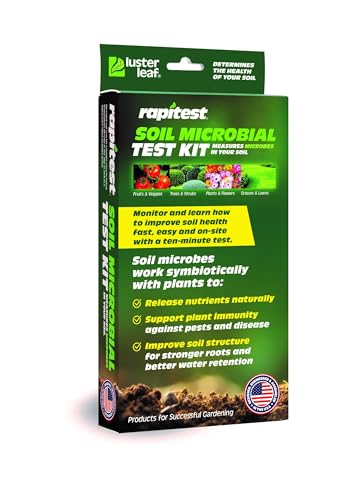
A lawn can receive nutrients and water while still lacking active soil biology. The Rapitest Soil Microbial Test Kit focuses on that less visible layer, using an app-guided process to assess microbial activity and connect the results with suggested soil amendments.
You do not need laboratory experience to follow the procedure, and guidance may point toward compost, kelp, mycorrhizae, biochar, worm castings, soil conditioners, or activators. The product was engineered and assembled in the United States, making it a distinct choice for gardeners focused on biological improvement rather than electrical measurements.
Positive Takeaways
✓App-based guidance helps translate microbial results into practical next steps.
✓The kit supports lawns and gardens without prior laboratory experience.
✓Results can guide the choice of compost, kelp, biochar, and similar amendments.
✓Smartphone guidance suits growers who want interpretation alongside the reading.
Less Ideal Details
•You need a compatible smartphone and the app to follow the guided process.
•The focus on microbial activity does not replace pH or separate nutrient measurements.
•Recommended amendments still need to match the condition and management of your lawn.
The Right Fit
The Rapitest kit suits regenerative gardeners who want to assess soil life and receive amendment guidance for lawn or garden care.
A Better Fit Elsewhere
The Luster Leaf 1818 4-in-1 Tester suits you better for quick physical checks of pH, moisture, fertility, and light without an app.
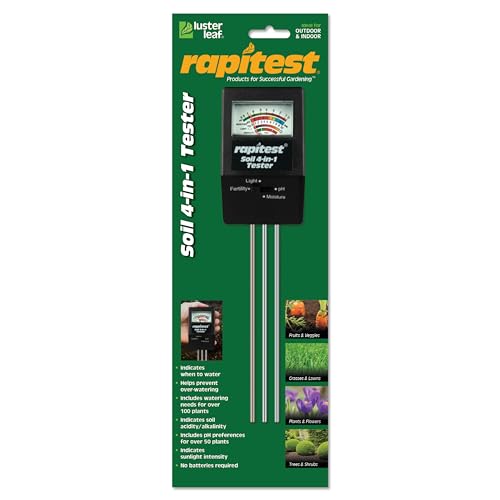
For a quick check of a lawn bed, container, or newly planted area, the Luster Leaf 1818 keeps the process simple. It combines four indicators: sunlight exposure, soil fertility, moisture, and pH, all accessed through a single probe-based meter.
Three probes support the different measurements, while the toggle controls let you move between gauges. You do not need batteries for operation, which removes a common ownership nuisance. Compared with the BDZMLITE 7-in-1, it offers fewer categories but a more focused tool for the four measurements many home growers check most often.
Useful Highlights
✓Four useful lawn and garden indicators appear in one compact meter.
✓The triple-probed design supports pH, moisture, fertility, and light checks.
✓Toggle controls make each gauge accessible without complicated settings.
✓Battery-free operation simplifies storage and routine use.
Details To Watch
•The fertility gauge does not provide separate nitrogen, phosphorus, and potassium values.
•Consistent probe placement improves the usefulness of comparisons between lawn areas.
•The four indicators cannot assess microbial activity or electrical soil resistivity.
Feature Snapshot
Feature
Specification
Why It Matters
Measurements
pH, moisture, fertility, and light
Covers four common growing checks
Probe arrangement
Triple-probed
Supports multiple soil and light readings
Power
No battery required
Reduces charging and battery replacement
Whose Shelf It Belongs On
The Luster Leaf 1818 belongs in a small garden shed where you want an uncomplicated meter for frequent spot checks.
Swap It Out When
The Rapitest Soil Microbial Test Kit is a better fit when soil biology and amendment guidance matter more than immediate meter readings.
## Match The Instrument To The Property Question
Start with the question behind your lawn concern. A moisture meter helps you decide whether irrigation is the immediate issue, while a pH reading can explain why certain nutrients become less available. Nutrient-specific kits focus on nitrogen, phosphorus, and potassium, and microbial kits examine another part of soil health entirely.
The two ETCR instruments belong on a different track. Earth resistance and soil resistivity describe how soil conducts electricity, a factor relevant to grounding systems, underground infrastructure, and industrial sites. Neither device replaces a lawn nutrient or moisture analysis.
Next, compare the amount of setup you can manage. The LaMotte kit follows a hands-on sequence with a chart, the Rapitest kit relies on app guidance, and the handheld meters emphasize immediate readings. Professional earth measurement introduces electrode placement, lead connections, and method selection that go well beyond a backyard lawn check.
Finally, think about storage and repeat use. A compact handheld meter can remain handy for frequent spot checks, while a larger field kit and protective case suit equipment stored between job sites. Match the instrument to the decision you actually need to make, not simply to the largest number of readings on the box.
### Read Ranges In Context
A wide measurement range only helps when it matches your conditions. The ETCR3200C reaches much higher resistance values through its wire methods than the ETCR2100A+ clamp approach, while the double-clamp range remains narrower. Check the expected conductor size, soil environment, and grounding configuration before selecting either model.
### Account For Consumables And Connectivity
Reagent-based kits provide specific nutrient categories but involve consumable tabs and color interpretation. Digital meters give quicker readings without those materials, although the results serve as broad indicators rather than detailed nutrient panels. App-guided kits add interpretation and amendment suggestions, but they also depend on a compatible phone and a more involved workflow.
### Decide How Much Detail You Need
A general lawn assessment can be as simple as moisture, light, and pH. Add separate nutrient analysis for fertilizer decisions, or microbial assessment when soil life and long-term soil health are central to your plan. Professional electrical work calls for an instrument designed around resistance methods, not a garden meter repurposed beyond its scope.
## Common Pitfalls In Soil Assessment
One frequent mistake is treating any probe reading as a complete diagnosis. Moisture, pH, light, nutrients, and biology describe different parts of the lawn, so use each measurement for its own purpose. Another common error is confusing electrical soil resistivity with nutrient quality; the two describe entirely different properties.
## What Separates Premium From Basic
Higher-tier instruments cost more because they add measurement modes, broader ranges, field protection, and more detailed interpretation. That extra capability matters for contractors, extensive properties, and repeated professional use. A homeowner checking a few lawn beds may get better value from a simple meter or a focused nutrient kit.
## Frequently Asked Questions
### Which soil test kit is most useful for a lawn?
The most useful kit matches the issue you need to resolve. Choose moisture and pH readings for irrigation questions, separate NPK results for fertilizer decisions, and microbial assessment for soil-biology management.
### Do I need a professional soil test for my lawn?
A home kit provides useful screening information for routine checks and comparisons between areas. A professional laboratory analysis offers a more detailed picture when persistent problems remain unclear or major fertilizer changes require better documentation.
### Can a soil meter replace a complete nutrient analysis?
No, a general fertility reading does not separate nitrogen, phosphorus, and potassium. Use a dedicated NPK kit when you need specific nutrient information before choosing fertilizer.
### What does soil resistivity mean for grass?
Soil resistivity describes how readily the soil conducts electricity. It can inform grounding and electrical-site work, but it does not directly reveal grass nutrient, moisture, or pH conditions.
### Which option needs no smartphone?
The BDZMLITE 7-in-1 Dual-Screen Soil Tester and Luster Leaf 1818 4-in-1 Tester provide direct handheld readings without app guidance. The Rapitest Soil Microbial Test Kit is the better choice for app-supported biological assessment.
## The Takeaway
The right lawn test kit depends on the decision ahead of you. LaMotte suits nutrient-specific fertilizer work, BDZMLITE covers the broadest set of quick home readings, Rapitest focuses on soil biology, and Luster Leaf keeps basic checks uncomplicated. The ETCR models serve professional electrical and soil-resistivity work, where their measurement methods matter more than lawn-care readings.