A nutrient tank can look balanced while its pH, the measure of how acidic or alkaline the water is, sits outside the range your plants prefer. For a home hydroponic system, a reliable meter turns guesswork into manageable readings, especially during nutrient changes or warm weather. The six options below cover everything from a simple conductivity check to a multi-parameter instrument with stored results.
A Fast Comparison Of The Options
PickWhy We Picked ItBest ForAction
Multi-Use Pick
Diknusite NEEGLEN Digital TDS Water Tester 0-9990 PPM Blue 1-Pack
Your first decision should be whether you actually need a pH meter or a dissolved-solids reading. This NEEGLEN model measures total dissolved solids, or TDS, which estimates the dissolved material in a solution; it does not report pH.
For a nutrient reservoir, that makes it a companion to a pH meter rather than a replacement. Its handheld format, 0-9990 PPM range, and one-inch immersion depth suit quick checks, although a true pH instrument gives you a more relevant view of nutrient availability.
The Case For It
✓The wide PPM range accommodates water with very different dissolved-solids levels.
✓A titanium-alloy probe gives the instrument a practical working surface for routine water checks.
✓The HOLD button keeps a reading visible while you prepare a nutrient adjustment.
✓A stated one-to-three-second response reduces the wait during repeated reservoir checks.
Things To Consider
•This is not a pH meter, so it cannot replace one in a system where acidity is your main concern.
•TDS indicates dissolved material but cannot identify which nutrients are present.
Key Specs
Feature
Specification
Why It Matters
Measurement
TDS from 0-9990 PPM
Suits a broad range of concentration checks.
Probe
Titanium alloy
Provides a durable surface for water contact.
Reading time
1-3 seconds
Keeps repeat checks concise.
Control
HOLD button
Preserves the displayed result temporarily.
Made For
You need a quick TDS reference alongside a separate pH meter, particularly for checking changes in a nutrient reservoir.
Consider Something Else When
Bluelab METCOM pH, Temperature and Conductivity Meter for Hydroponics suits you better when one instrument must cover pH, temperature, and conductivity.
Where the NEEGLEN stops at TDS, the Apera SX711 addresses pH directly with 0.01 pH resolution. Automatic temperature compensation, or ATC, adjusts the reading as water temperature changes, which matters in reservoirs exposed to daylight and ambient heat.
The lead-free probe, automatic calibration, and included buffers make this a sensible option for growers who want more control over their measurement routine. In a busy growing room, its stored readings can also help you compare conditions across multiple visits.
Everyday Advantages
✓Fine pH resolution gives you a more detailed view than a coarser display.
✓Automatic one- to three-point calibration reduces repetitive manual steps.
✓The included lead-free ATC probe keeps temperature compensation in the measurement setup.
✓Data logging preserves 100 sets of measurements for later comparison.
Minor Gripes
•Its field-oriented kit is more elaborate than a basic pen-style meter.
•The handheld format provides occasional readings rather than continuous monitoring.
Quick Facts
Feature
Specification
Why It Matters
pH resolution
0.01 pH
Supports close comparison of small changes.
Calibration
Automatic, 1-3 point
Supports repeatable setup.
Stored readings
100 data sets
Allows comparisons between sessions.
Built With In Mind
You want detailed measurements and recorded results for hydroponic research, crop monitoring, or water-quality work away from a bench.
Another Choice May Suit
General Tools DPH7011 Digital pH Meter offers a simpler portable option when you need pH alone and prefer a pocket-sized format.
Compared with the Apera SX711, this meter strips the workflow down to a pocket-sized digital display. Automatic temperature compensation keeps the pH reading aligned with the water temperature, while the broad 2-to-16 pH range covers acidic and alkaline conditions.
Its IP-57 waterproof housing and floating body are particularly practical around damp reservoirs. You also receive pH 4 and pH 7 buffer solutions, a soaking solution, four AAA batteries, and a carrying case for routine maintenance.
Notable Gains
✓The floating body is easier to retrieve from a tank or reservoir.
✓Automatic temperature compensation supports readings in changing water temperatures.
✓Buffer solutions and a separate soaking solution support the care routine.
✓The pocket format suits a small growing area or mobile check.
Practical Considerations
•The RS-232 output requires compatible equipment for data transfer.
•The pH range is broad, so you may want additional resolution information before choosing it for fine adjustments.
Right Fit For
You need a straightforward pH meter for occasional reservoir checks and value a floating, pocket-sized design.
Look Elsewhere When
Apera SX711 Portable pH/mV/Temperature Meter Kit fits you better when stored records and finer pH resolution justify the added complexity.
For repeated checks in a grow tent or reservoir, a dedicated pH pen keeps the process focused. The Bluelab pH Pen offers ±0.1 pH accuracy, a practical level for routine monitoring where you mainly need to see whether the water has moved outside your target range.
Its double-junction probe uses two liquid junctions to separate the sensing and reference sides of the electrode. For a grower comparing this focused tool with the broader Bluelab METCOM, the distinction is simple: this pen answers pH questions without adding conductivity or temperature displays.
Strengths Worth Knowing
✓The pen format keeps routine pH checks direct and uncomplicated.
✓±0.1 pH accuracy gives a clear indication of meaningful reservoir changes.
✓The double-junction probe suits the mixed growing media named in its intended applications.
✓Its focused design travels easily between a grow room and another water container.
Trade-Offs
•It measures pH rather than conductivity, temperature, and pH in one unit.
•The ±0.1 range is less detailed than the Apera SX711’s 0.01 resolution.
Feature Snapshot
Feature
Specification
Why It Matters
pH accuracy
±0.1 pH
Supports practical routine monitoring.
Probe
Double junction
Separates sensing and reference sides.
Format
Pen-style meter
Suits portable reservoir checks.
Readings
pH
Focuses on acidity monitoring.
Use areas
Hydroponics, pools, aquariums, brewing
Allows use beyond a grow room.
Who Will Love This
You want a straightforward pH pen for frequent spot checks and do not need conductivity readings in the same instrument.
Where A Sibling Pick Shines
Bluelab pH and Conductivity Kit suits you better when you need separate pH and conductivity pens with backlit displays.
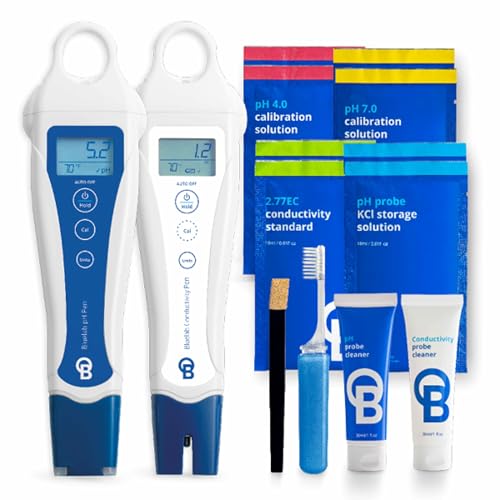
Two measurements usually anchor a hydroponic routine: pH for acidity and electrical conductivity, or EC, for dissolved material that indicates the broader strength of the solution. This Bluelab pack puts both in separate pen-style instruments, giving a beginner two essential readings without a complicated console.
Both pens include temperature readings in Celsius and Fahrenheit, along with bright backlit displays that remain visible in dim growing spaces. Their compact shape also suits mobile use, although the two-device format means your checks happen in sequence.
The Practical Payoff
✓The paired pens cover pH and conductivity, two central parts of reservoir monitoring.
✓Backlit screens improve readability in shaded tents and storage rooms.
✓Temperature can be shown in either Celsius or Fahrenheit.
✓Compact pens are easy to carry between containers.
Possible Compromises
•You use two pens rather than one combined display.
•Separate measurements take slightly more handling than a multiparameter unit.
Made For
You are building a first routine around pH and conductivity and prefer compact instruments with highly visible screens.
Where Another Pick Suits Better
Bluelab METCOM pH, Temperature and Conductivity Meter for Hydroponics suits you better when one handheld unit is preferable to carrying two pens.
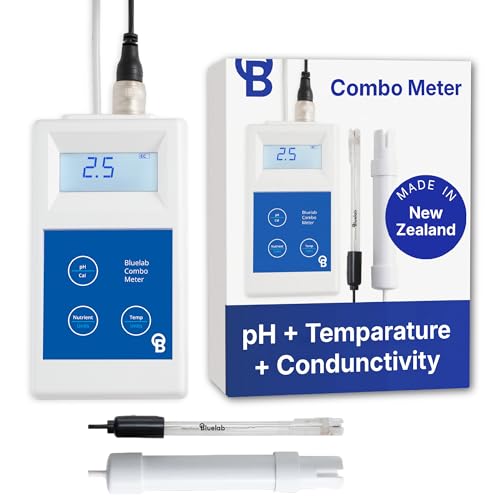
For one reservoir check, the Bluelab METCOM brings together the three measurements that shape many feeding decisions: pH, temperature, and conductivity. Automatic temperature compensation helps maintain reading consistency as the water temperature changes, while the double-junction pH probe provides a practical electrode design for varied solutions.
Its EC, TDS, and PPM display options connect electrical conductivity with the concentration scales commonly used in grow rooms. You still need to interpret the result, though, because none of these readings identifies individual nutrients or tells you which adjustment a crop requires.
Useful Highlights
✓One instrument handles pH, temperature, and conductivity measurements.
✓Automatic temperature compensation supports changing reservoir conditions.
✓EC, TDS, and PPM scales make the conductivity result easier to connect with familiar routines.
✓The combined format reduces the need to carry separate pens or meters.
Small Caveats
•Multiple readings mean more controls and display information than a single-purpose pH pen.
•Conductivity and TDS describe overall concentration rather than the identity of each nutrient.
Core Details
Feature
Specification
Why It Matters
Measurements
pH, temperature, conductivity
Covers the main reservoir readings in one device.
Conductivity scales
EC, TDS, PPM
Offers familiar ways to view concentration.
Best Suited To
You want one meter to monitor pH, temperature, and nutrient-solution concentration during regular hydroponic maintenance.
A Better Fit Elsewhere
Bluelab pH Pen ±0.1 Accuracy suits you better when you only need pH and prefer the simplest routine for repeated spot checks.
## What Matters in a Hydroponic pH Meter
### pH Resolution and Temperature Compensation
A pH reading near the edge of your target range may call for a small adjustment, so resolution deserves attention. The Apera SX711 offers 0.01 pH resolution, while the Bluelab pH Pen lists ±0.1 accuracy. Automatic temperature compensation, or ATC, matters whenever reservoir temperature changes enough to affect the electrode reading.
### Calibration and Included Supplies
Calibration aligns the meter with known buffer solutions, allowing it to produce a meaningful result. The Apera kit includes ready-to-use buffers and automatic calibration, while the General Tools package includes pH 4 and pH 7 solutions. You should also consider storage, probe care, and how often you expect to take readings.
### pH, EC, and TDS Are Different Measurements
pH describes acidity, while electrical conductivity estimates dissolved material through the ability of a solution to conduct electricity. TDS translates conductivity into a dissolved-solids estimate, so the numbers are related but not interchangeable. A dedicated pH meter, a paired pH and conductivity kit, and a multiparameter meter serve different monitoring routines.
### Portability Versus Recorded Results
A floating or pen-style design is convenient for a small grow area and occasional checks. A handheld instrument with data logging supports comparisons across visits, which can be useful when you need to relate a pH shift to a feeding or temperature change.
## Mistakes Worth Dodging
A TDS meter cannot replace a pH meter, so confirm the actual measurement before buying. Do not treat EC, TDS, and PPM as separate nutrient readings, and check the calibration supplies listed with the instrument. A larger display is helpful, but resolution, ATC, and a maintenance routine matter more during regular use.
## What The Higher Tier Buys
Higher-tier instruments may add finer pH resolution, automatic calibration, stored results, or combined temperature and conductivity readings. Those additions help when you compare repeated samples or monitor a larger system. For a single small reservoir, a focused pH pen may cover your needs with fewer controls to manage.
## Frequently Asked Questions
### Do I need a pH and EC meter for hydroponics?
A pH meter shows how acidic or alkaline the solution is, while an EC meter estimates overall dissolved concentration. Having both gives you a more complete view of the reservoir.
### Can a TDS meter replace a pH meter?
No. TDS estimates dissolved material, while pH measures acidity, so the two readings answer different questions.
### How often should I calibrate a hydroponic pH meter?
Calibrate before an important measurement session and whenever a stable reading changes unexpectedly. Follow the manufacturer’s calibration and probe-care instructions for the specific instrument.
### Is a higher-resolution pH reading always necessary?
Not always. A ±0.1 pH reading may suit routine monitoring, while 0.01 pH resolution becomes more useful when you track small changes between closely timed measurements.
### Which option is simplest for a beginner?
The Bluelab pH and Conductivity Kit offers two focused pens with backlit displays. You may prefer the Bluelab METCOM pH, Temperature and Conductivity Meter for Hydroponics when carrying one instrument matters more than using separate pens.
## Final Verdict
Your best fit depends on the measurements you actually need. A dedicated pH pen handles routine acidity checks, a paired kit covers pH and conductivity, and a multiparameter meter brings everything into one device. Use that distinction to avoid paying for functions your growing routine will not use.