

A garden hose left running through a sudden shower can undo an entire morning’s watering. A water timer gives you scheduled control, rain delays, and remote adjustments, so your plants receive water consistently without requiring constant attention. These options cover everything from simple mechanical programming to WiFi control, solar power, and four-zone scheduling.
The Lineup, Simplified
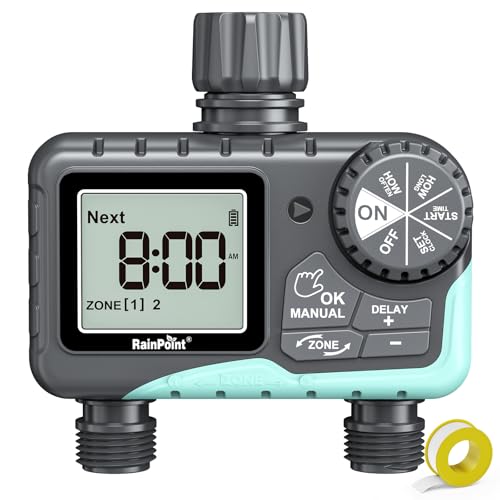
RAINPOINT 2-Outlet Programmable Sprinkler Timer with Rain Delay
RAINPOINT WiFi Water Timer with Hub, App, and Voice Control

RAINPOINT Solar Sprinkler Timer

Gardena Water Timer 1888

RAINPOINT 1-Outlet Programmable Sprinkler Timer with Rain Delay and Manual Mode

RAINPOINT 4-Zone Programmable Sprinkler Timer with Rain Delay
Why These Options Stand Out
A spigot feeding both a flower bed and a soaker line gives you two jobs to coordinate, and the RAINPOINT 2-Outlet Programmable Sprinkler Timer keeps both on separate schedules. Each outlet can have its own start time, duration, frequency, and end time, while the two can also run together. That makes the model useful for yards where beds and lawns need different watering patterns.
Its controls provide more scheduling depth than the Gardena Water Timer 1888, though you do not gain phone-based control. Bright white markings on the dial and buttons improve visibility during setup, and a display alerts you when the battery falls below 5%. For most two-zone homes, that is a practical balance of flexibility and direct operation.
Useful Touches
- Independent zone settings prevent one planting area from inheriting another area’s schedule.
- Thirty-eight programs offer room for recurring frequencies and separately controlled start and end times.
- Manual operation lasts up to eight hours, while automatic runs can reach four hours.
- Hourly schedules cover 1 to 12 hours, with day-based cycles extending from one to seven days.
- The low-battery warning and automatic shutdown reduce the chance of an unnoticed leak from a depleted battery.
Practical Considerations
- Thirty-eight programs and separate zone controls may feel detailed for a new gardener with one basic watering line.
- The one-minute minimum runtime is precise but offers little room for a very brief misting cycle.
Feature Snapshot
Who It Suits Best
You benefit most from this timer when one faucet serves two distinct planting areas that need separate watering schedules.
A Better Fit Elsewhere
Choose RAINPOINT WiFi Water Timer with Hub, App, and Voice Control instead when you need to change schedules away from home.
Unexpected heat during a weekend away can make a fixed schedule a poor match for thirsty containers. The RAINPOINT WiFi Water Timer with Hub, App, and Voice Control lets you start, stop, or revise preset plans from your phone, while the hub handles the connection between your home network and the watering hardware. That remote access is the defining advantage over the two-outlet model with local controls.
Two zones can each hold one to three daily plans, with independent start times, durations, and frequencies. You can also monitor water consumption in gallons or liters and pause either zone for 24, 48, or 72 hours after rain. For a larger property, the hub supports up to four compatible WiFi timers and includes a connected outlet of its own.
Good Reasons To Consider
- Phone control lets you respond to changing weather without asking someone to visit the faucet.
- Each zone supports up to three daily plans, giving you several routines without reaching for several timers.
- Built-in flow measurement provides a clear record of water use in gallons or liters.
- Rain delays can cover three set lengths and can be applied to one zone without stopping the other.
- The hub can remain connected to compatible timers positioned as far as 328 feet away.
Points To Keep In Mind
- The connection requires 2.4 GHz WiFi, so a home network set exclusively to 5 GHz will need adjustment.
- Hub placement, app setup, and network compatibility add more steps than a simple dial-based timer.
Quick Facts
Made For Remote Control
This model fits gardeners who regularly travel or need to adjust watering plans from a phone without visiting the outdoor faucet.
Where A Sibling Pick Shines
RAINPOINT 4-Zone Programmable Sprinkler Timer with Rain Delay is more appropriate when you need four local zones without a hub and app.
A timer mounted at the edge of a bed can spend weeks outside without a nearby outlet or a fresh battery. The RAINPOINT Solar Sprinkler Timer uses a solar panel to recharge an internal battery, offering a practical alternative to battery replacement routines. Under normal watering frequency, one full charge is stated to last up to 21 days.
Brass inlet and outlet connections support regular hose attachment, while the ABS housing carries an IP65 weather-resistance rating. You can schedule watering every 1 to 12 hours or every 1 to 7 days, with run times from one minute to three hours and 59 minutes. Compared with the two-outlet model, this is a focused single-zone setup for a faucet serving one irrigation system.
What Stands Out
- Solar charging reduces the need for routine battery replacements at an exposed faucet.
- The stated 21-day runtime gives you a useful operating window between full charges under normal use.
- Brass hose connections suit garden faucets, sprinkler hoses, and drip irrigation lines.
- Rain delay and manual watering provide useful ways to pause or supplement a preset schedule.
Trade Offs
- One outlet limits the timer to a single irrigation zone, so separate watering lines need another scheduling method.
- Actual solar charging depends on the panel receiving suitable sunlight, making its location an important setup consideration.
The Right Fit
You benefit most from this solar model when one standard garden faucet serves a soaker hose, sprinkler line, or drip system in an exposed outdoor location.
Another Choice May Suit
RAINPOINT 1-Outlet Programmable Sprinkler Timer with Rain Delay and Manual Mode is a closer fit when a conventional battery-powered timer suits your setup better.
Two rotating knobs make the Gardena Water Timer 1888 approachable when you are setting up your first automatic watering schedule. You select a watering frequency and run time from 17 preset combinations, then connect the included hose fitting. Weather-resistant electronics suit an outdoor faucet, while the straightforward interface keeps setup away from apps and complicated menus.
This is a narrower tool than the RAINPOINT 2-Outlet Programmable Sprinkler Timer with Rain Delay, which provides separate settings for two outlets and as many as 38 programs. The Gardena model makes more sense for one line and a limited set of recurring routines. The honest read is that its simplicity is the feature, not a shortcoming, for a straightforward garden.
Useful Highlights
- Two clearly operated knobs reduce the number of settings you need to learn.
- Seventeen frequency and run-time combinations cover common weekly watering patterns.
- The included hose connector supports a direct setup at a compatible garden faucet.
- Weather-resistant electronics suit routine outdoor placement.
Factors To Consider
- Seventeen combinations provide less scheduling variety than the multi-program RAINPOINT models.
- A single connection cannot independently manage separate beds or drip-irrigation zones.
Key Product Details
Built With In Mind
This model suits first-time gardeners who want dependable preset timing for a single watering line without navigating a digital interface.
Consider Something Else When
RAINPOINT 1-Outlet Programmable Sprinkler Timer with Rain Delay and Manual Mode offers more precise timing and weather-related controls for a single zone.
A single garden line attached to a soaker hose does not always need a multi-zone controller, but it still benefits from adjustable timing. The RAINPOINT 1-Outlet Programmable Sprinkler Timer with Rain Delay and Manual Mode lets you set a start time, a duration from one minute to three hours and 59 minutes, and a frequency ranging from hourly to weekly.
Rain delay pauses the programmed schedule for 24, 48, or 72 hours before it resumes, while manual mode gives you an immediate option for spot watering. Compared with the Gardena Water Timer 1888, this model provides more precise duration choices and a weather-related pause, although it also has a more involved programming interface.
The Practical Payoff
- Start time, duration, and frequency can be adjusted for one complete watering line.
- Three rain-delay periods let you postpone a schedule after a substantial rainfall.
- Manual watering gives you immediate control without losing the stored program.
- Minute-level run times suit both brief cycles and nearly four-hour irrigation sessions.
Some Limits To Know
- One outlet means the timer cannot independently control two irrigation areas.
- The maximum automatic duration of three hours and 59 minutes is shorter than the longest run offered by the WiFi model.
Who Will Love This
You benefit most from this model when a single soaker hose or sprinkler line needs flexible timing, automatic rain delays, and occasional manual watering.
Reach For A Different Pick When
Gardena Water Timer 1888 is easier to manage for a new gardener who values preset combinations and two knobs over digital programming.
One faucet often ends up serving a lawn, flower bed, vegetable row, and drip line in a large garden, each with its own moisture needs. The RAINPOINT 4-Zone Programmable Sprinkler Timer with Rain Delay gives each of those outlets its own start time, duration, and frequency. That zone count makes local control more practical than using the two-outlet model for a similarly divided property.
Rain delay and manual watering add useful controls for changing conditions without abandoning the configured programs. Unlike RAINPOINT WiFi Water Timer with Hub, App, and Voice Control, this model focuses on local programming rather than phone-based changes. For you, that means fewer network requirements, but also no remote adjustments while you are away.
What Makes Sense
- Four independent zones serve several distinct areas from one programmed timer.
- Separate start times, durations, and frequencies prevent every planting area from sharing one schedule.
- Rain delay supports a temporary pause after wet weather.
- Manual mode gives you an immediate watering option when a quick adjustment is needed.
Worth Noting
- A four-zone setup requires four planned irrigation lines and careful hose organization at the faucet.
- Local programming suits a permanent setup, while travelers may prefer phone-based remote controls.
Technical Highlights
Best Suited To
This timer suits gardeners with a multi-area landscape who want four local schedules without adding a WiFi hub and app.
Where Another Pick Suits Better
RAINPOINT WiFi Water Timer with Hub, App, and Voice Control fits you better when remote schedule changes matter more than local four-zone control.
What Matters Before You Choose a Water Timer
Zone Count and Layout
Start by counting the areas that genuinely need separate schedules, not just the number of hoses available. A single line can be handled by a one-outlet timer, while planting beds with different moisture requirements benefit from independent zones. For four or more areas, check that the faucet and hose arrangement can support the layout you have in mind.
Power and Connectivity
Battery-powered models avoid installation wiring and keep setup simple. Solar models remove routine battery replacement, yet you need a location where the panel receives suitable sunlight. WiFi timers add phone access and usage reports, but they require a 2.4 GHz network, a hub, and compatible app setup. Choose remote control only when you will use it.
Schedule Flexibility
Look closely at the minimum run time, maximum duration, and available frequencies. Minute-level settings suit drip lines that need short cycles, while longer runs suit sprinkler hoses. More programs help only when your garden has several recurring patterns. Otherwise, a smaller set of clear presets may make daily operation easier.
Rain and Manual Control
A rain delay protects the schedule after wet weather, with options commonly ranging from one to three days. Manual watering gives you a way to water one area immediately without changing stored programs. For most outdoor installations, having both controls provides a useful balance between automation and hands-on flexibility.
Watering Details That Prevent Setup Regrets
Mistakes Worth Dodging
Choosing by timer count alone can leave you with a unit that cannot separate the areas you planned to water. Check the faucet connection, hose type, zone requirements, and power location before ordering. For WiFi models, confirm that your home network provides 2.4 GHz connectivity.
What Separates Premium From Basic
Basic timers concentrate on preset frequencies and simple controls, while premium models add more schedules, multi-zone control, remote access, or solar charging. The added expense is worthwhile only when the extra control solves a problem in your garden. Otherwise, a simpler timer can handle the job with less setup.
Frequently Asked Questions
Can one water timer run two zones?
Yes, a two-outlet model can run two independent schedules, and a four-zone model expands that control to four areas. Each zone can have its own timing settings when the model supports programmable zones.
Do WiFi water timers need a hub?
The RAINPOINT WiFi model includes a hub that connects to compatible timers and your home network. The connection uses 2.4 GHz WiFi, so check your network settings before installation.
How long does the solar timer charge last?
The stated operating time is up to 21 days under normal watering frequency. Charging time and runtime depend on sunlight exposure and how often the timer operates.
Are basic mechanical timers suitable for beginners?
They can be, especially when you need one line and a limited set of recurring schedules. The Gardena model uses two knobs and 17 preset combinations to keep programming straightforward.
How many watering zones do you need?
Count each area that needs a different start time, duration, or watering frequency. Similar areas can share a schedule, while lawns, beds, and drip lines often need separate control.
Bottom Line
Your decision comes down to complexity, control, and the number of watering areas involved. Start with the Gardena model for a simple single line, use a RAINPOINT two- or four-zone timer for distinct local schedules, and choose the WiFi or solar versions when remote access or reduced battery maintenance fits your garden. The right choice is the one whose controls match how you actually water.
