A raised bed can look productive before the first vegetable emerges, but the growing medium determines how roots handle water, nutrients, and space. You need a dependable base for herbs, greens, flowers, or container crops, and you may also need an amendment to improve drainage or feed plants over time. These options cover full bed fills, soil conditioners, liquid food, and slow-release granules, helping you match each product to the job your garden actually needs.
Rosy Soil Plant Food is a feeding amendment rather than a complete growing medium, so its place in a raised bed is beside established soil or container mix. That distinction matters because the four-quart package is designed to support houseplants, herbs, flowers, succulents, tropical plants, and outdoor containers, not fill an entire bed frame by itself.
For a patio bed crowded with mixed containers, the organic blend can add feeding support without requiring a separate product for every plant type. Its ingredient list includes biochar, kelp, worm castings, compost, bokashi, and mycorrhizae, giving you a more complex amendment than a basic plant-food granule. The honest read is that this serves focused container and indoor setups especially well.
Notable Upsides
✓Feeds a broad range of houseplants, herbs, flowers, succulents, and tropical plants.
✓Uses natural ingredients and contains no peat or synthetic additives.
✓Supports both indoor containers and outdoor container plantings.
✓Biochar, kelp, compost, and worm castings provide varied inputs in one blend.
Things To Consider
•This is plant food, not a standalone bed-filling medium.
•Four quarts may cover only a modest collection of containers rather than a large raised bed.
Made For
This option fits gardeners raising mixed houseplants and edible or ornamental plants in containers, including raised beds built primarily from pots.
Another Choice May Suit
Organic Plant Magic Compressed Organic Potting Soil is a better fit when you need an actual planting medium to fill a bed or replace exhausted container soil.
Vermiculite is a lightweight mineral amendment used to improve the structure of potting soil and growing media. Unlike Rosy Soil Plant Food, which focuses on feeding, Gardenera gives you a material for managing aeration and moisture within a raised-bed mix.
Gardeners working with dense soil or containers appreciate the balance between drainage and water retention. It can support seed starting and rooting cuttings, and the manufacturer also identifies raised beds, container gardening, orchids, hydroponics, and terrariums as suitable uses. Medium grade makes it a versatile amendment rather than a highly specialized horticultural material.
The Practical Payoff
✓Lightweight material is easier to carry and mix into soil.
✓Improves pore space so roots can receive oxygen within dense media.
✓Helps soil retain moisture while supporting drainage.
✓Useful across raised beds, pots, seed starting, and propagation work.
Compressed potting soil solves a practical storage problem: a bulky bag of loose medium takes up far more room than it needs before hydration. Organic Plant Magic packs coconut coir and worm castings into granules that expand as you add water, with the original material described as making up to three gallons of soil.
That makes it a useful full-medium option for a new raised bed, a container overhaul, or a small garden where storage space is limited. Compared with Gardenera’s vermiculite, this is a complete planting medium rather than something intended only for blending into existing soil. The trade-off is that you need to prepare and hydrate it before filling the bed.
A Few Highlights
✓Expands up to four times its compressed size when mixed with water.
✓Produces up to three gallons of growing medium from the compressed material.
✓Combines coconut coir with worm castings for a complete planting base.
✓Works for garden plants, vegetables, and indoor containers.
✓The compact, resealable package is easier to store than loose soil.
Practical Considerations
•Water and mixing are required before the granules become a usable planting medium.
•The expanded volume still needs enough prepared space and a container with drainage.
Feature Snapshot
Feature
Specification
Why It Matters
Expansion
Up to 4x with water
Reduces storage and carrying bulk
Expanded yield
Up to 3 gallons
Provides a useful volume for containers and small beds
Base ingredients
Coconut coir and worm castings
Creates a blended growing medium with organic inputs
Right Fit For
This compressed medium fits small-space gardeners who want convenient storage, indoor-outdoor flexibility, and a ready-to-use soil alternative.
Consider Something Else When
Gardenera Horticultural Organic Vermiculite suits gardeners who want to condition existing soil rather than replace it with a new medium.
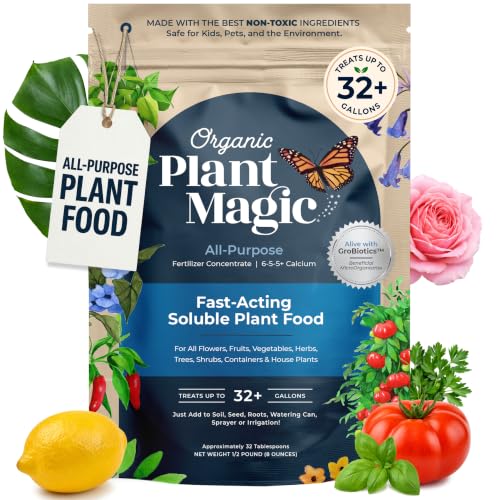
Where Organic Plant Magic Compressed Organic Potting Soil provides the bed medium, this concentrated liquid plant food handles a different task. The half-pound package is a water-soluble concentrate that makes more than 32 gallons of liquid feed, making it useful for repeated watering across an active raised bed.
You can apply the same product to vegetables, flowers, herbs, fruit, trees, gardens, and indoor houseplants. That versatility is useful for a gardener tending a vegetable bed and several pots on the same patio. It does not change the soil’s physical structure, so you still need a sound base medium.
Where It Excels
✓The concentrate produces more than 32 gallons of liquid plant food.
✓One formula covers vegetables, flowers, herbs, fruit, trees, and houseplants.
✓The small dry package is easy to store and mix as needed.
Points To Note
•This is a fertilizer rather than soil, compost, or a structural amendment.
•You need a container and water to prepare the liquid feed before application.
Important Details
Feature
Specification
Why It Matters
Package weight
1/2 lb
Offers a compact quantity of concentrated feed
Prepared yield
32+ gallons
Supports multiple watering sessions
Application form
Water-soluble concentrate
Integrates with routine plant watering
Plant coverage
Vegetables, flowers, herbs, fruit, trees, and houseplants
Reduces the need for separate food products
Composition
Organic plant food
Provides feeding through an organic fertilizer format
Made With In Mind
This liquid feed suits gardeners who already have suitable growing soil and want one simple food for vegetables, ornamentals, and houseplants.
Another Choice May Suit
Organic Plant Magic Slow Release Granular Fertilizer fits raised beds where you prefer top-dressing the soil instead of preparing liquid feed.
Slow-release granules suit raised beds where you want fertilizer placed in the soil without preparing a liquid mixture. You can add the granules to planting holes, mix them with soil, apply them as a top dressing by hand, or spread them across the bed.
Compared with Organic Plant Magic Plant Food, the format trades precise mixing for easier placement. It also covers a wide range of growing situations, including flowers, vegetable gardens, fruit trees, shrubs, and houseplants. For most seasonal beds, that flexibility makes granular feeding straightforward, though the four-pound bag needs a storage place away from dampness.
Good Reasons To Consider
✓Slow-release granules suit beds where repeated liquid feeding is inconvenient.
✓The fertilizer can be placed in planting holes, mixed into soil, or top-dressed.
✓Hand application makes it accessible to smaller raised beds.
✓One granular product covers vegetables, flowers, fruit trees, shrubs, and houseplants.
Small Caveats
•Granules must be placed according to the product directions so plants receive an appropriate amount.
•Keep the four-pound package dry and sealed between applications.
Whose Shelf It Belongs On
This option fits vegetable and flower gardeners who prefer a low-fuss granular food for seasonal beds and container plantings.
Reach For A Different Pick When
Organic Plant Magic Plant Food is a better fit for gardeners who already mix liquid fertilizer into their watering routine.
PlantBest Coco Peat Garden Soil is a concentrated coconut-coir medium designed to replace bulky peat-based bags. The 11-pound block expands to approximately 79 quarts, or 2.65 cubic feet, which gives you a useful volume of growing medium without storing a similarly sized loose bag.
Compared with Organic Plant Magic Compressed Organic Potting Soil, both use compressed coir, but this option is presented as a peat-free garden medium rather than a coir-and-worm-castings blend. Triple washing and low salt content make it appealing for gardeners who pay close attention to the condition of their growing media. Hydration and expansion still take place before use.
What Helps Most
✓Expands from an 11-pound block into approximately 79 quarts.
✓Concentrated packaging reduces bulk compared with loose potting soil.
✓Peat-free coconut coir suits gardeners avoiding traditional peat media.
✓Triple washing and low salt content support a clean growing medium.
Things That May Matter
•The compressed block must be hydrated and expanded before planting.
•Peat-free coir is a growing medium, not a substitute for a complete fertilizer program.
Quick Facts
Feature
Specification
Why It Matters
Package
11-lb compressed block
Stores more compactly than loose medium
Expanded volume
Approximately 79 quarts or 2.65 cubic feet
Provides a measurable amount for filling beds and containers
Best Suited To
This medium fits peat-free raised-bed gardeners and container growers who value compact storage and a sizable expanded volume.
Look Elsewhere When
Organic Plant Magic Compressed Organic Potting Soil is a better fit when you want worm castings included in the compressed planting medium.
## What Matters Before You Fill A Raised Bed
### Start with the bed, not the bag
A full bed needs a growing medium that gives roots room, holds enough moisture for daily use, and drains away excess water. A fertilizer or vermiculite can improve an existing mix, but neither replaces the base material needed to fill the frame. Check the bed depth and planting method before deciding between a complete medium and an amendment.
### Match the amendment to the job
Vermiculite handles structure, adding aeration and moisture retention to a mix. Rosy Soil focuses on feeding container plants, while the two Organic Plant Magic fertilizers cover liquid feeding and slow-release granules. Your plants’ needs and your preferred application method should determine which category belongs in the cart.
### Calculate volume before buying
Measure the interior length, width, and depth, then multiply those dimensions to estimate cubic feet. Compare that result with the expanded volume listed for compressed products. For loose amendments, estimate how much of the bed’s total volume you plan to replace rather than assuming the full bag will be needed.
## Getting The Details Right
### Mistakes Worth Dodging
Do not treat fertilizer as soil or assume an amendment can fill an empty frame by itself. Avoid buying a compressed medium without checking its expanded volume and available hydration space. Mixing products does not automatically improve a bed, so choose the one job that needs attention first.
### The Case For Spending Up
A more costly option may provide a larger expanded volume, a longer feeding cycle, or a carefully processed base medium. That added expense makes sense for a large bed, a demanding crop schedule, or a gardener who values concentrated storage. A smaller amendment remains sensible when the existing soil is already in good condition.
## Frequently Asked Questions
### Do raised beds need potting soil or garden soil?
Raised beds often benefit from a light, well-drained potting medium because their root zones are contained and can dry differently from open ground. Existing soil can still be improved with an appropriate amendment, provided it has suitable structure and drainage for the crops.
### Is fertilizer the same as soil for a raised bed?
No, fertilizer supplies nutrients while soil or potting medium provides the root-zone structure. A raised bed generally needs a suitable base medium, plus fertilizer when the nutrient supply is inadequate or the plants require additional feeding.
### Can vermiculite fill a raised bed by itself?
Vermiculite is better used as an amendment mixed with a suitable base medium. Its role is to improve aeration, drainage, and moisture retention rather than supply the entire root zone on its own.
### How much soil does a raised bed need?
Multiply the bed’s interior length by its width and depth to calculate its volume in cubic feet. Compare that figure with the expanded volume of compressed products or the quantity of loose medium you intend to add.
### Is coco coir suitable for raised-bed gardening?
Coco coir can serve as a raised-bed growing medium because it provides a lightweight, peat-free alternative to traditional peat products. Choose it when its water-retention characteristics and fertilizer needs align with the plants you plan to grow.
## Wrap Up
The right growing input depends on the job: use a complete medium to fill the bed, vermiculite to improve its structure, liquid food for flexible feeding, or slow-release granules for convenient top-dressing. Rosy Soil Plant Food remains most relevant to mixed container plantings rather than whole-bed filling. Match the format to your space, crops, and routine, then start with one clear purpose rather than a crowded collection of amendments.