

A neglected hedge can turn a quick Saturday cleanup into an afternoon of reaching, clipping, and handling a noisy machine. Professional-looking results depend less on power than on blade length, cutting capacity, balance, and the reach your shrubs actually require. These cordless options cover compact touch-ups, established hedges, and elevated foliage without the fuel storage of a gas trimmer.
Your Options, Compared

WORX 20V Hedge Trimmer WG261

WORX 20V Hedge Trimmer WG263

WORX 20V Grass and Shrub Trimmer WG801

WORX 40V Hedge Trimmer WG286
WORX 20V Pole Trimmer WG252

WORX 20V Pole Trimmer WG252.9
What Each Pick Brings To The Table
Reaching the top of a dense hedge with a full-size trimmer often means stretching, wobbling, and making uneven cuts. The WORX WG261 addresses that awkwardness with a 22-inch blade, a front D-grip for directional control, and a 5.5-pound body that stays manageable through longer sessions.
Its dual-action hardened steel blades move in opposite directions to reduce vibration while cutting through twigs. For most home landscapes, that combination makes it a practical middle ground between the compact WG801 and the longer WG286.
Bright Spots
- The 22-inch blade covers more hedge per pass than a small grass shear.
- The 5.5-pound weight reduces strain during overhead shaping.
- The front D-grip supports precise cuts along the hedge face.
- Dual-action steel blades help smooth the cut and limit vibration.
Things To Consider
- Its full-length blade needs more storage room than the WG801.
- The 20-inch cutting head of the pole model offers a different approach to tall shrubs.
Key Specs
Made For
This model suits homeowners and property caretakers who shape medium-to-large hedges and want cordless freedom without an oversized pole.
Another Choice May Suit
The WORX WG801 suits you better when compact storage and light detail work matter more than a 22-inch cutting span.
The WG263 carries the same useful 22-inch format as the WG261 but adds a stated cutting capacity for twigs and branches up to one inch thick. That distinction matters when your hedge contains woody growth rather than only soft, seasonal growth.
Its 20V PowerShare battery can also serve a broader collection of more than 140 compatible tools and outdoor power equipment. You gain a stronger fit for multi-device households, although the full 22-inch blade still requires a deliberate storage plan.
Practical Advantages
- Cuts twigs and branches up to one inch thick.
- The 22-inch span suits larger hedges and compact shrubs.
- One battery platform supports a broad tool collection.
- You avoid fuel mixing and engine maintenance.
Practical Considerations
- One-inch capacity is a branch limit, not a promise that every woody stem will cut cleanly.
- The 22-inch length remains less convenient for tight storage than a compact shear.
Feature Snapshot
Right Fit For
This trimmer fits households that already use compatible 20V tools and want one battery platform for several outdoor projects.
Look Elsewhere When
The WORX WG286 is the better fit for a 40V system, a 24-inch blade, and dense hedges with substantial branch growth.
Not every missed leaf needs a full-size hedge trimmer. The WG801 handles small shrubs and detail work with interchangeable 4-inch and 8-inch cutting heads, making it the practical choice for patios, compact gardens, and quick cleanups between larger jobs.
At two pounds, it offers a noticeably different handling profile from the 22-inch WG261 and WG263. A soft-grip handle adds comfort, although the short blade naturally makes this model less suitable for sweeping across a long hedge.
The Case For It
- The 2-pound body supports fine motor control.
- Two cutting heads suit both small leaves and thicker stems.
- Soft grip improves comfort during detail work.
- The compact format simplifies storage and carrying.
Room For Improvement
- A full hedge requires more passes than a 22-inch or 24-inch blade.
- You may find the 8-inch head more useful for shrubs than long rows of hedge.
Built With In Mind
This model is well suited to apartment residents, beginners, and gardeners who mainly shape small shrubs and finish stray branches.
Swap It Out When
The WORX WG261 fits you better when a long hedge and fewer passes take priority over compact storage.
The WG286 is the full-scale choice for established hedges that need more cutting span than the WG263 provides. Its 24-inch blade and 40V power platform target dense landscaping work, while the stated one-inch branch capacity covers woody stems without changing tools.
You trade a little maneuverability for reach and cutting authority, which is a sensible exchange for straight rows and deep hedges. The battery-powered design also removes fuel storage, engine upkeep, and cord management from the job.
What Helps Most
- The 24-inch blade covers more hedge per stroke.
- 40V power suits demanding trimming tasks.
- Branches up to one inch thick fit its stated capacity.
- Fuel-free operation simplifies yard logistics.
Less-Strong Areas
- The longer blade needs more clearance during turns and storage.
- Its 40V platform differs from the 20V tools used by the other models here.
Technical Highlights
Who Should Grab It
Choose this model for serious residential maintenance, larger properties, and straight hedges that justify a 24-inch blade.
Reach For A Different Pick When
The WORX WG801 suits you better for small shrubs, light touch-ups, and compact storage rather than dense mature hedges.
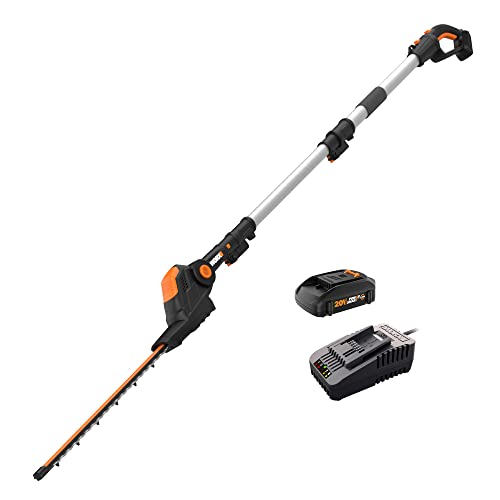
A pole trimmer changes the geometry of hedge work. The WG252 reaches up to 12 feet, while its 10-position cutting head rotates to suit the top, sides, and underside of dense foliage without forcing you into an awkward stance.
Its 20-inch head and 2-in-1 attachment capability make this a flexible tool for elevated shrubs and broader yard tasks. Compared with the WG263, it reduces the need for ladders, although the extended pole requires more room to maneuver and store.
Key Advantages
- The telescoping pole reaches up to 12 feet.
- Ten head positions handle varied cutting angles.
- Twenty-inch blade covers elevated hedge sections efficiently.
- Attachment capability broadens its yard-tool role.
Points To Keep In Mind
- Plan storage space for the extended pole assembly.
- Compact shrubs offer little benefit from the added reach.
Best Suited To
This model fits property owners with tall hedges, overhead branches, or a need to keep a ladder out of routine trimming.
Where A Sibling Pick Shines
The WORX WG263 fits you better for dense ground-level hedges where a standard 22-inch blade offers simpler handling.
For straight elevated trimming, the WG252.9 keeps the central advantage of the WG252: a 20-inch cutting head mounted on a telescoping pole with up to 12 feet of reach. The adjustable head provides ten positions for approaching the top and side of a hedge.
This version offers a more focused path for a property whose main requirement is reach rather than attachment versatility. You may find the pole less useful around low shrubs, and its extended shape calls for a clear storage location.
A Few Strong Suits
- Twelve-foot reach tackles elevated foliage.
- Ten head positions make angle changes straightforward.
- The 20-inch head handles substantial hedge sections.
- 20V operation avoids fuel and extension cords.
Small Caveats
- Low shrubs do not need this much extension.
- The pole requires a longer storage footprint.
Essential Details
Whose Shelf It Belongs On
This pole trimmer suits homeowners focused on tall hedges and elevated shrubs across a medium or large property.
Consider Something Else When
The WORX WG252 is the better fit when attachment capability is important alongside extended pole reach.
Matching The Tool To Your Hedge Work
Start With Hedge Size
A 4-inch or 8-inch grass shear suits small shrubs and detail work. A 20-inch pole head handles elevated sections, while 22-inch and 24-inch blades cover long hedges with fewer passes. Measure both the foliage and your available cutting space before deciding.
Check The Branch Diameter
Branch capacity tells you whether the tool can handle woody growth. The WG263 and WG286 list capacity for branches up to one inch thick, which is more useful for established shrubs than a machine intended only for leaves and fine shoots.
Compare Battery Platforms
A 20V system makes sense for homes that already own compatible 20V outdoor tools. The WG286 uses a higher-voltage platform for heavier work, while pole and compact models favor the lower-voltage platform. Confirm your existing batteries and intended tool collection before committing.
Account For Reach And Storage
Pole reach reduces ladder work, but a telescoping assembly needs room to store. Full-size blades also need clearance during turns. Choose the longest tool your storage area and typical shrub height can handle without making every task more awkward.
Practical Lessons Before You Buy
Mistakes Worth Dodging
Choosing solely by voltage overlooks blade length and branch capacity. A powerful machine can still be inconvenient for small shrubs. Match the cutting head to the hedge first, then use voltage and battery compatibility to refine the choice.
What The Higher Tier Buys
The WG286 adds a 24-inch blade and 40V power for dense hedges and fewer passes. That extra capability helps with substantial woody growth, while a 20V or compact model remains more sensible for lighter work.
Frequently Asked Questions
Which WORX hedge trimmer is best for large hedges?
The WORX WG286 offers the longest blade at 24 inches and uses a 40V platform, making it suitable for large, dense hedges. The WG263 provides a lighter 20V alternative with a 22-inch blade.
Can a pole hedge trimmer replace a ladder?
A pole trimmer can reduce the need for a ladder by extending your reach to elevated branches. Safe ladder practices and local access conditions still matter, especially around unstable ground.
What matters most for thick hedge branches?
Blade construction and stated branch capacity are the most useful checks. The WG263 and WG286 list capacity for branches up to one inch thick, so they suit sturdier growth better than compact grass shears.
Are 20V and 40V hedge trimmers interchangeable?
The voltage platforms serve different power requirements and may use different battery systems. You should check battery compatibility before assuming one model can use the batteries from another.
Which model takes up the least storage space?
The WORX WG801 is the most compact option because it uses 4-inch and 8-inch cutting heads. Pole models require additional room for their telescoping shafts, while full-size trimmers need clearance for their longer blades.
Closing Remarks
Your best match depends on the shape of the work: the WG801 handles small details, the WG261 and WG263 cover conventional hedges, the WG286 tackles denser growth, and the pole models add reach. Start with the largest branch and tallest hedge you maintain, then choose the smallest tool that handles those demands comfortably.
