A shady strip beside the house can defeat the sun-loving plants crowding your other beds. The right choice depends on how much light reaches the area, how wet the soil stays, and whether you want a low lawn, colorful foliage, or a taller focal point. These options cover several practical situations, from dense shade beneath trees to partially sunny borders and patchy turf.
A large tree can cast enough shade to discourage ordinary lawn grass, yet Zoysia remains a practical candidate for partly lit ground. These 36 plugs are individual pieces of sod, each measuring 3 by 3 inches, making them a manageable way to fill sparse sections rather than installing an entire new lawn at once.
Unlike seed, which begins as tiny seedlings, plugs arrive with established roots and soil around them. That gives the grass a head start in closing thin spots, although they still need time to knit into a continuous lawn. For most homeowners, the combination of shade, drought, and salt tolerance makes this a flexible choice for transitional areas.
Practical Advantages
✓Handles both open sun and partial shade, reducing the need for separate grass types in mixed-light yards.
✓Drought tolerance means less watering than many conventional lawn grasses during dry spells.
✓The thick, soft blades suit areas used for family gatherings and outdoor play.
✓Each rooted plug simplifies patching bare areas without preparing a full seedbed.
Practical Considerations
•Plan for the plugs to expand and merge into continuous turf rather than expecting immediate coverage.
•Winter shipments can arrive dormant, meaning temporarily inactive, so seasonal timing matters.
Quick Facts
Feature
Specification
Why It Matters
Package quantity
36 plugs
Useful for patch repairs and gradual lawn expansion
Plug dimensions
3 by 3 inches
Provides an already-rooted starting piece
Environmental tolerance
Drought, salt, and shade
Supports several difficult growing conditions
Made For
You want a durable lawn or repaired patch where sunlight varies and dry periods are common.
A Better Fit Elsewhere
Black Beauty Dense Shade fits lawn areas where sunlight is much more limited than partial shade.
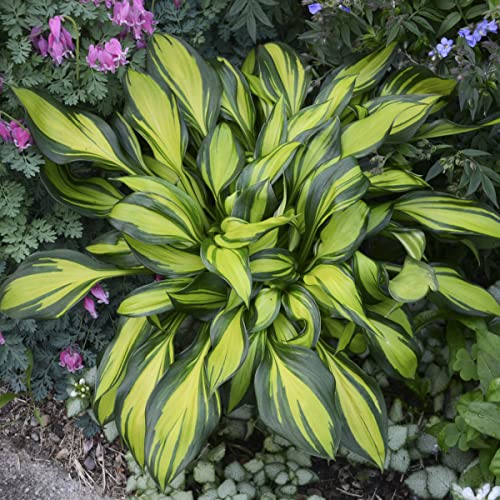
A dark corner rarely needs more foliage, but it can benefit from leaves that carry their own pattern. Rainbows End is a variegated hosta, meaning its foliage combines several colors: yellow centers, deep green margins, and a creamy middle that becomes more pronounced in summer.
This starter perennial is a small, young plant intended to grow into a medium mound over time. It brings late-summer red flower stalks topped by dark lavender blooms, so the planting offers interest beyond its leaves. That combination makes it especially useful beside a shaded porch, under a tree canopy, or in a colorful container.
Features That Help
✓Multicolored foliage gives shaded beds visible detail without relying on flowers.
✓The perennial returns in later growing seasons after settling into its site.
✓Red stalks and tubular lavender flowers add a second stage of seasonal interest.
✓A compact, medium mound works well near paths and in containers.
Small Caveats
•The pale central coloring becomes more visible in summer, so the plant’s appearance shifts through the season.
•Leave room for both the foliage mound and the late-emerging flower stalks.
Feature Snapshot
Feature
Specification
Why It Matters
Leaf pattern
Yellow, dark green, and cream
Creates contrast in low-light beds
Growth habit
Medium foliage mound
Fits borders, paths, and containers
Flowers
Red scapes with dark lavender tubes
Adds late-summer color
Who Will Love This
You enjoy foliage-focused gardening and want a patterned perennial for a shaded container or border.
Where Another Pick Suits Better
Green Promise ‘Landmark’ Rhododendron suits a larger border that needs evergreen height and spring flowers.
Rainbows End supplies color at ground level, while ‘Landmark’ creates a taller focal point for a partially shaded border. Its evergreen foliage retains dark brown to nearly black leaves, setting a dramatic backdrop for large red flowers tinged with lavender when the buds open in early May.
The plant arrives rooted in soil and can go into the ground upon arrival, subject to suitable weather. A mature height and spread of 5 to 6 feet makes it more than a small accent, so its footprint deserves attention. In a group, several plants can form an informal hedge or repeated sequence of spring color.
Good Reasons To Consider
✓Evergreen foliage provides year-round structure beneath the flowering stems.
✓Red flowers with lavender accents create a strong spring display in partial shade.
✓Bronze-toned winter foliage adds seasonal color beyond the bloom period.
✓The rooted container is ready for planting when conditions are suitable.
✓Pruning after flowering is straightforward, helping you control its eventual size.
Practical Considerations
•Moist, well-drained soil is important, while a persistently soggy location is a poor fit.
•Its eventual 5-by-6-foot footprint calls for more room than a compact flowering plant.
The Right Fit
You have a roomy border in USDA Zones 5 through 8 and want a tall evergreen accent for partial sun.
Another Choice May Suit
HostaKing Rainbows End Hosta suits smaller shaded spaces where colorful foliage matters more than height.
Moving from ornamental plants to lawn seed changes the scale of the decision. This 25-pound bag contains turf-type tall fescues, a cool-season group suited to lawns that experience both warm and cold periods. Its dark green color, consistent leaf texture, and resistance to shredding during mowing make it useful across a broad range of home settings.
The drought-related features give it a useful edge in sunny or partly shaded lawns. Its roots can grow as deep as four feet, while a waxy coating on the leaves helps reduce moisture loss during hot weather. That makes this a sensible option for a yard that receives regular foot traffic but does not have the intense shade of a dense tree canopy.
Everyday Advantages
✓Deep roots support the grass during periods of limited rainfall.
✓The waxy leaf surface helps conserve moisture in warm conditions.
✓Uniform, dark green blades create a consistent appearance across a lawn.
✓Tall fescue handles both sunny and partly shaded areas without changing seed types.
Worth Noting
•Seeding during mid-August through mid-October offers favorable ground warmth and cooler nights, with mid-March through mid-May as the next suitable period.
•A 100% tall fescue blend provides less compositional variety than a multi-grass lawn seed.
Technical Highlights
Feature
Specification
Why It Matters
Composition
100% turf-type tall fescue
Keeps the lawn visually consistent
Root potential
Up to four feet
Adds drought resilience
Leaf surface
Waxy coating
Helps preserve moisture
Preferred seeding period
Mid-August to mid-October
Uses warm soil and cooler nights
Built With In Mind
You want a low-maintenance cool-season lawn across a yard with both open and partly shaded sections.
Swap It Out When
Black Beauty Dense Shade fits the narrower problem of maintaining turf beneath large trees, shrubs, or buildings.
Where Jonathan Green Tall Fescue concentrates on a single grass type, Black Beauty Ultra takes a broader approach. The 25-pound mix is intended for two common lawn projects: establishing a new seeded yard and filling bare sections in a thin or damaged lawn. Its rapid germination, meaning the point when seeds begin growing, supports a quicker start.
The result is described as healthy, dense turf with dark green color, and the mix includes tall fescue among its grass types. For a large renovation, that combination gives you flexibility without forcing the entire yard into one uniform species. The honest read is that this is a general lawn-building choice rather than a narrowly targeted shade solution.
Where It Delivers
✓Rapid germination makes the seed useful for both new yards and bare-spot repairs.
✓Dense, dark green turf offers a consistent appearance across seeded areas.
✓The multi-grass formulation provides flexibility for broad lawn projects.
Possible Compromises
•A mixed formula gives you less control when you want every blade to come from one turf type.
•It addresses general lawn establishment rather than concentrating specifically on the deepest shade pockets.
Best Suited To
You are starting a new lawn or repairing several bare patches and want a versatile multi-grass seed.
Look Elsewhere When
Black Beauty Dense Shade suits a lawn whose defining challenge is very limited sunlight beneath mature trees.
Some lawns are shaded only during part of the day, while others sit beneath a canopy that blocks nearly all direct sunlight. This 25-pound seed blend is made for that more difficult second situation, with shade-tolerant grasses selected for areas beneath large trees, substantial shrubs, houses, and other permanent structures.
Its mixture includes four grass types, allowing the lawn to draw on several turf characteristics rather than relying on a single variety. The intended outcome is dense, dark green growth in locations where light is limited. Compared with Black Beauty Ultra, this option is more deliberately focused on the shade part of the lawn project.
Everyday Wins
✓Shade-tolerant grasses address areas where sunlight penetration is limited.
✓Four grass types add flexibility to the finished lawn’s composition.
✓The blend is designed for dark green, dense turf beneath major landscape obstructions.
Details To Watch
•This purpose-built shade mix is less targeted to an open lawn than Jonathan Green Tall Fescue.
Core Details
Feature
Specification
Why It Matters
Package size
25 pounds
Supports lawn-scale seeding projects
Grass composition
Four grass types
Provides a broader mix of turf characteristics
Light requirement
Shade tolerant
Suits areas with limited sunlight penetration
Made For
Your lawn has persistent shade beneath mature trees, large shrubs, or buildings and needs dedicated seed.
Where A Sibling Pick Shines
Jonathan Green Tall Fescue suits yards where sun and partial shade share the space and drought resilience is the priority.
## Matching Shade, Soil, and Mature Size
### Read the Light Pattern First
Start by noting where sunlight actually falls, not merely which side of the house faces north. Morning sun is gentler than intense afternoon light, so a border beside an eastern wall may suit more options than one under a mature tree on the west side. Watch the area across the day and across the growing season for a realistic picture.
### Check Moisture and Drainage
Shade often stays damp because trees and buildings limit evaporation. Most of these plants still need moisture, but saturated soil can be just as troublesome as dryness. Hosta and rhododendron benefit from moist, well-drained ground, while the grass choices need enough water to germinate and establish before their drought-related characteristics become useful.
### Account for the Mature Footprint
A small starter plant can eventually become a substantial focal point, and sod plugs spread into a wider carpet as they establish. ‘Landmark’ reaches 5 to 6 feet in both height and spread, so a narrow bed may become crowded faster than expected. Match the eventual size to the available area, including room for maintenance access.
### Match the Form to the Project
Choose sod plugs for a defined patch or a gradual new lawn, and use seed for broader seeded areas. Container plants suit patios, entryways, and compact beds where changing the display is useful. The key is to decide whether you want a turf surface, a colorful foliage feature, or a taller evergreen before choosing the planting method.
## Two Costs That Often Change the Decision
### Mistakes Worth Dodging
Do not judge shade by one visit, and do not select a plant solely because its listing includes the word “shade.” Check the mature size, soil conditions, and seasonal appearance first. Avoid combining a moisture-loving plant with a persistently soggy corner, and do not assume a small container plant will remain compact without checking its mature dimensions.
### When Paying More Pays Off
A higher amount may reflect a named cultivar, a larger container, a specialized seed formulation, or another feature you can evaluate directly. It is worth paying more when the extra distinction serves your site, such as evergreen structure, a particular variegation pattern, or a seed mix designed around limited sunlight.
## Frequently Asked Questions
### Can Zoysia sod plugs grow in partial shade?
Yes, these plugs are designed to tolerate both sunny and partially shaded conditions. They still need time to spread and form an even lawn.
### Which seed is designed for the deepest shade?
Black Beauty Dense Shade is the most purpose-specific option for lawns beneath large trees, shrubs, buildings, and other structures that limit sunlight. The other Jonathan Green choices address broader lawn conditions.
### Do hostas require a sunny location?
No, hostas are suited to shady garden settings where direct sun is limited. Rainbows End also brings patterned foliage and late-summer flower stalks to those locations.
### How large does the ‘Landmark’ rhododendron become?
The mature size is approximately 5 to 6 feet tall and 5 to 6 feet wide. It suits a border or informal hedge with enough room for its eventual spread.
### Should a shaded lawn use sod or seed?
Sod plugs repair defined gaps and put rooted turf into the ground, while seed works well for larger seeded areas. Dense Shade seed is the more targeted choice for persistent shade, and the planting method should follow the size of the project.
## Final Verdict
Begin with the light pattern, then match the planting form to the space. Zoysia plugs and Black Beauty Dense Shade tackle lawn challenges, while the hosta and rhododendron bring color and structure to shaded borders. The most useful choice is the one that fits the soil, mature dimensions, and amount of light your yard actually provides.