Illinois gardens can look dependable in April and disappear by midsummer unless your perennials cover different windows of the season. Cold winters, warm summers, and variable soil make thoughtful plant selection more important than simply buying a large quantity of seeds. These six options include regional reference books, spring bulbs, mixed wildflower seed, and individual perennial varieties, giving you both careful planning and ready-to-plant options.
A regional garden reference can save you from treating every perennial as if it belongs in every climate. This illustrated book covers 86 perennial types and 605 recommended cultivars, with cultivars meaning named garden forms selected for particular traits.
For most upper-Midwest gardeners, that level of comparison helps narrow a long catalog into plants suited to cold conditions. The next book focuses on neighboring Ohio, but this Minnesota and Wisconsin volume offers a broader Upper Midwest perspective for beds, borders, and mixed perennial plantings.
Strengths Worth Knowing
✓Detailed coverage of 86 perennial types supports informed garden planning.
✓Recommendations for 605 cultivars help you compare named variations within a plant family.
✓Illustrations make flower and foliage details easier to recognize before planting.
✓Practical regional guidance is useful for a mixed or newly established garden.
Things To Consider
•The book centers on Minnesota and Wisconsin rather than Illinois, so local suitability still needs checking.
•Its broad cultivar coverage makes it more useful as a reference than a quick seasonal planting guide.
Key Specs
Feature
Specification
Why It Matters
Perennial types
86
Provides a broad reference for bed planning
Recommended cultivars
605
Expands the range of choices within each plant type
Regional focus
Minnesota and Wisconsin
Offers guidance for cold Upper Midwest gardens
Who It Suits Best
This book fits new Illinois gardeners and experienced planters who want a detailed regional reference before choosing long-term perennials.
Another Choice May Suit
Debra Knapke and Alison Beck’s Perennials for Ohio may fit your garden better when you prioritize a reference centered on a state bordering Illinois.
Ohio sits directly east of Illinois, making this illustrated guide a practical regional reference for gardeners who want climate-relevant ideas close to home. It profiles 89 perennial types and names 626 recommended cultivars, giving you substantial variety within each category.
Compared with Minnesota and Wisconsin Perennials, this book covers more Ohio-specific plant choices, although you may still need to adjust for your exact Illinois location. The illustrations and cultivar lists make it especially useful while comparing mature size, foliage, and flower form across a planned bed.
Features That Help
✓Profiles of 89 perennial types provide a solid starting point for border design.
✓Recommendations spanning 626 cultivars make side-by-side variety selection easier.
✓Useful illustrations help you visualize color, flower shape, and plant structure.
Practical Considerations
•Its guidance is organized for Ohio, so it is not a direct Illinois planting manual.
•You will still need to account for your soil, rainfall pattern, and local winter conditions.
Made For
This reference suits Illinois gardeners near the Ohio border and anyone who values detailed regional cultivar recommendations over a compact seed assortment.
Look Elsewhere When
Garden Elements Dutch Master Narcissus Daffodil Bulbs, Yellow, 50 Pack suits you better when you want to add a specific spring display rather than plan an entire perennial border.
The Dutch Master narcissus delivers a familiar golden trumpet flower at a useful time, bringing structure and color to borders before summer perennials reach their size. Its 16-to-22-inch height works particularly well along paths, at the middle of a bed, or in a grouped planting.
Unlike the broad planning material in Ohio Perennials, this 50-bulb pack gives you a defined planting project. Depending on your soil, you may need to prepare drainage carefully, but the bulbs can occupy full sun or partial shade and naturally spread over successive seasons.
Useful Touches
✓Golden-yellow trumpet blooms create a clear focal point in early to midspring.
✓Fifty bulbs support grouped displays instead of isolated single plants.
✓Full-sun and partial-shade flexibility helps you place them around existing beds.
✓Deer and rodents tend not to favor the bulbs, reducing one common landscape concern.
Small Caveats
•Plant from September through November for the intended spring flowering cycle.
•Naturalizing means the bulbs multiply over time, so allow room in a permanent border.
Feature Snapshot
Feature
Specification
Why It Matters
Pack size
50 bulbs
Provides enough for a grouped planting
Mature height
16–22 inches
Adds upright structure to spring beds
Planting period
September–November
Sets the bulbs up for spring growth
Light
Full sun to partial shade
Expands placement options around a garden
Right Fit For
This pack fits homeowners who want dependable early spring color along paths, entrances, or the middle of mixed perennial borders.
Swap It Out When
Lawn Seed Feed All Perennial Wildflower Seed Mix, 2 oz is a better fit for creating a varied meadow-style planting rather than a concentrated display of one flower.
A mixed perennial sowing suits gardeners who want variety without selecting every species by hand. This 2-ounce wildflower mix is intended for gardens, meadows, and landscapes, with its native-prairie emphasis and partial-shade suitability giving it a broader planting role.
Unlike the five distinct packets from Gardeners Basics, this option creates a blended stand where height and color will develop across the collection. The resealable pouch also helps protect unused seed between sowings, which is useful in a large bed or for keeping leftovers through the season.
Positive Takeaways
✓A mixed seed blend provides greater plant and flower variety than a single-variety packet.
✓Pollinator use makes it well suited to meadow borders and informal landscapes.
✓Partial-shade suitability broadens where you can establish the mix.
✓The resealable pouch helps protect seed remaining after an initial sowing.
✓Deer resistance offers a useful trait for many residential landscapes.
Details To Watch
•A blended meadow look will not suit a bed that needs tightly coordinated plant heights.
•Partial shade can reduce flowering in species that favor stronger light.
•Follow the packet’s coverage guidance before spreading the entire pouch across a small area.
Quick Facts
Feature
Specification
Why It Matters
Net weight
2 oz
Offers a practical quantity for mixed outdoor sowing
Package
Resealable pouch
Helps protect unused seed between plantings
Who Will Love This
This mix appeals to wildlife gardeners and homeowners creating informal meadow beds, pollinator borders, or low-maintenance landscapes.
Reach For A Different Pick When
Gardeners Basics 5 Perennial Seed Packets suit you better when you need specific, separately labeled varieties for a controlled flower bed.
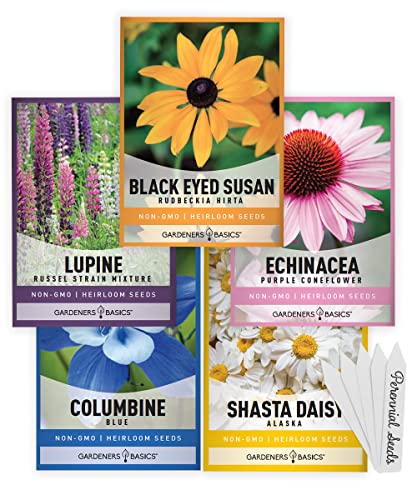
Five separately labeled packets make it easier to plan a colorful bed without committing to one species. The collection includes Russell lupine, blue columbine, purple coneflower, black-eyed Susan, and Alaska Shasta daisy, combining tall accents, bright flowers, and familiar garden forms.
For first-time perennial growers, the selection offers a manageable introduction, and the heirloom, non-GMO seed provides a clear starting point. Unlike the blended wildflower mix, each packet lets you decide where individual plants belong, which is helpful for coordinating colors and spacing across a formal border.
Notable Upsides
✓Five recognizable varieties create a varied planting without a large seed catalog.
✓Individual paper packets simplify sorting and help you keep varieties separate.
✓Heirloom, non-GMO seed appeals to gardeners seeking traditional perennial varieties.
Some Limits To Know
•Starting from seed requires time for germination, establishment, and routine thinning.
•The assortment offers a starting palette rather than continuous color across the entire growing season.
Best Suited To
This seed set fits beginners and methodical gardeners who want five distinct perennial varieties for a new bed or container-based starting point.
Consider Something Else When
Garden Elements Dutch Master Narcissus Daffodil Bulbs, Yellow, 50 Pack makes more sense when you want a finished spring display instead of starting several varieties from seed.
Blanket flower brings a warm, two-color presence to a sunny perennial bed. This Gaillardia aristata offering produces red blossoms with yellow tips, and its drought and heat tolerance makes it a sensible choice for exposed borders where moisture can fluctuate.
Compared with the five-packet Gardeners Basics set, this option concentrates on one distinctive perennial rather than spreading your attention across several species. You may find it especially useful beside paths or within a mixed planting, and the same flowers can also be cut for indoor arrangements.
A Few Highlights
✓Red flowers with yellow tips create strong visual contrast in a border.
✓Drought and heat tolerance suit sunny gardens with less consistent moisture.
✓The flowers work outdoors and as cut stems for the house.
✓Each packet contains at least 600 mg of seed, equivalent to about 260 seeds.
✓Detailed planting directions cover depth, spacing, and germination timing.
Points To Note
•The stated 14-to-21-day germination period applies under the recommended soil temperatures.
•Allow the listed spacing so mature plants have room for their natural spread.
Technical Reference
Feature
Specification
Why It Matters
Seed quantity
At least 600 mg, about 260 seeds
Supports repeat sowing or multiple planting areas
Germination
14–21 days at 70–75°F
Defines the expected emergence window and soil temperature
Planting depth
1/8 inch
Places the seed at the shallow depth it requires
Spacing
12–18 inches apart
Allows room for mature blanket flowers
Packet
Full-color packet
Helps identify the variety and planting directions at a glance
Built With In Mind
This seed fits sunny-border gardeners who want a single heat-tolerant perennial that provides both garden color and cut flowers.
Not Your Match When
Perennials for Minnesota and Wisconsin may suit you better when you need broad regional planning information rather than one heat-tolerant variety.
## What Matters Before Planting In Illinois
### Match The Plant To Your Site
Sunlight and drainage shape the practical limits of a perennial garden. Daffodils accept sun or partial shade, while blanket flower is a natural fit for a sunny, drier border. Check where water collects after heavy rain before choosing plants for an area with slow drainage.
### Build A Sequence Of Blooming Periods
A dependable bed rarely depends on one flower. Daffodils supply early spring structure, the Gardeners Basics collection adds several recognizable summer and early-fall types, and the wildflower mix can create a less formal sequence across a landscape. Staggering bloom times reduces the bare gaps that appear after early bulbs finish.
### Decide Between Seeds And Bulbs
Bulbs offer a defined planting project with a predictable flower form, while seeds require more attention to timing, establishment, and thinning. The five labeled perennial packets give you control over individual varieties, whereas the wildflower mix trades that precision for a blended, meadow-style result.
### Use Regional Guides As Starting Points
Minnesota, Wisconsin, and Ohio books can help narrow your choices, but a plant still needs to fit your Illinois location. Check mature size, bloom period, soil preference, and local climate details before committing a perennial to a permanent bed.
## Common Mistakes Worth Avoiding
### Mistakes Worth Dodging
Choosing by flower color alone can leave gaps in height, bloom time, and maintenance. A healthier plan starts with site conditions, then adds plants that serve different seasons and positions in the bed.
### What The Higher Tier Buys
A regional reference book adds more detailed plant profiles and cultivar choices than a basic seed packet, but it does not replace checking your local conditions. The practical upgrade is better decision support, not a guarantee that every listed plant belongs in your garden.
## Frequently Asked Questions for Perennials For Illinois
### Which Perennials Should I Plant In Illinois?
Choose perennials suited to your sunlight, soil drainage, and local climate, then group plants by mature size and bloom period. Daffodils work well for early spring, while blanket flower fits sunny borders where heat and dry soil are common concerns.
### Are Daffodils Perennials For Illinois Gardens?
Daffodils are perennial bulbs that can return and multiply in suitable conditions. Plant them from September through November in well-drained soil, and give them enough space for their natural spread.
### Is It Better To Plant Perennial Seeds Or Bulbs?
Bulbs suit gardeners seeking a specific flower with less establishment work, while seeds provide broader variety and lower upfront commitment. Seeds require attention to planting timing, young plant care, and thinning as the bed develops.
### Can Perennial Wildflower Mixes Grow In Partial Shade?
Some perennial wildflower mixes can be planted in partial shade, although light-loving species may produce fewer flowers. Soil moisture, seed variety, and the amount of daily sunlight all affect the final display.
### Which Regional Perennial Book Is More Useful For Illinois?
Ohio Perennials offers a regional reference from a state bordering Illinois, while Minnesota and Wisconsin Perennials provides a broader Upper Midwest perspective. Compare local climate and soil conditions with the plant details in either book before deciding.
## Final Verdict
The right perennial choice depends on what you need from the garden: a regional plan, a concentrated spring display, a varied meadow, or a specific sunny-border flower. Use the books to narrow your options, then confirm local fit before planting. For an easy first step, choose the option that matches your site and your willingness for ongoing care.