A bonsai pot can hold a surprising amount of moisture, especially when its soil contains fine organic matter. That makes watering decisions harder than they look, and a moisture meter for bonsai gives you a quick physical reference alongside your finger test. The six options below range from simple probe meters to connected monitoring kits, with several specialized instruments included to clarify where each type belongs.
The Shortlist At A Glance
PickWhy You Picked ItBest ForAction
Top Pick
Censinda Soil Moisture Monitor, 12.6-Inch Long Probe for Indoor and Outdoor Plants, Garden, Lawn
Reaching the root zone matters in a shallow bonsai pot, where the top layer may feel dry before the center has lost much moisture. The Censinda Soil Moisture Monitor uses a 12.6-inch probe, making it more useful for deeper containers than a short household-plant meter. Its 1-to-10 dial also provides a simple reference without batteries or a phone connection.
You can use this meter across indoor displays, outdoor benches, and larger planted containers, provided the probe can enter the soil without striking a stone. Compared with the two-meter Tennedriv Green set, Censinda emphasizes reach rather than quantity. For a single deep pot, that is the more useful trade.
The Practical Payoff
✓The 12.6-inch probe reaches farther into pots and planters.
✓Its dial gives immediate readings without batteries.
✓One meter serves indoor and outdoor plant care.
✓The 1-to-10 scale separates dry, normal, and wet conditions.
Practical Considerations
•The broad dial offers less precision than a digital display.
•Do not leave the probe buried or insert it into standing water.
•Hard soil, stones, and roots can damage the probe.
Key Specs
Feature
Specification
Why It Matters
Probe length
12.6 inches
Improves access to the root zone in deep pots.
Moisture range
1 to 10
Shows dry, normal, and wet soil bands.
Product size
16 by 2.5 by 1.5 inches
Shows the meter’s overall storage footprint.
Power
No battery required
Avoids battery replacement during routine checks.
Who It Suits Best
This meter suits bonsai growers with deeper pots who want a simple reading without configuring electronics.
A Better Fit Elsewhere
ECOWITT GW1106 Soil Moisture Kit suits you better when remote phone-based readings matter more than a simple dial.
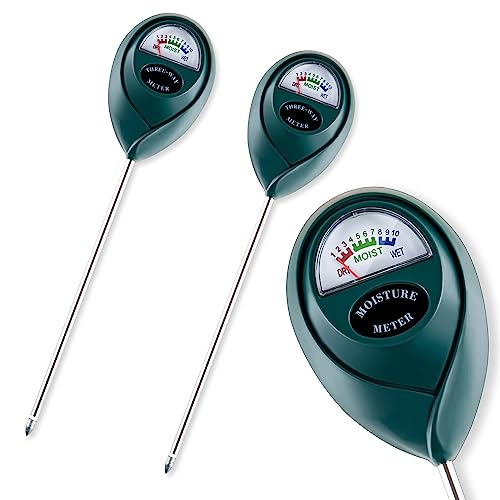
Two small bonsai can sit on opposite ends of a bench, and checking each with the same meter means repeatedly cleaning and relocating one probe. Tennedriv Green solves that inconvenience with a two-pack, giving you one meter for each location. The lightweight construction and large gauge also keep the daily routine uncomplicated.
Unlike the Censinda Soil Moisture Monitor, this set emphasizes compact access and two-meter convenience rather than a long probe. Depending on your pot depth, you may find that the shorter format works best for shallow containers. It remains a practical choice for beginners and anyone managing multiple small trees nearby.
Notable Upsides
✓Two meters support separate plant locations.
✓The large dial is easy to read quickly.
✓No batteries are required for operation.
✓The lightweight body is easy to handle.
Small Caveats
•The compact probe may be less useful in deep containers.
•Wipe the probe after each use to preserve accuracy and hygiene.
•Neither meter should remain buried in the soil.
Made For
This set fits beginners and small-tree owners who want two simple meters for separate benches or windowsills.
Look Elsewhere When
Censinda Soil Moisture Monitor suits you better when probe depth matters more than having two complete meters.
The R6200 is built for a completely different measurement task, so it does not belong in your bonsai watering kit. It assesses workplace heat stress through WBGT, a composite reading that accounts for temperature, humidity, air movement, and radiant heat. That makes it useful for outdoor work, studios, and other hot environments where the feeling of heat depends on more than temperature alone.
Unlike the REED R6010, which scans moisture within building materials, the R6200 measures the surrounding environment. Its broader set of readings may still support plant-care planning, but it cannot tell you whether the root zone of a bonsai is dry. Treat it as a specialist environmental instrument rather than a soil-moisture solution.
Well-Handled Touches
✓It combines several heat and environmental measurements.
✓WBGT accounts for humidity and radiant heat.
✓An adjustable audible alarm supports monitoring.
✓The display also shows heat index, dew point, and pressure.
Where It Is Less Suited
•It does not measure moisture inside bonsai soil.
•The range of readings adds complexity for casual plant care.
•It is designed around heat assessment rather than watering.
Technical Highlights
Feature
Specification
Why It Matters
Primary index
WBGT
Combines heat and humidity for workplace assessment.
Additional readings
Heat index, dew point, and pressure
Adds context beyond a basic temperature check.
Alarm
User-adjustable audible alert
Provides a signal when a selected threshold is reached.
Right Fit For
This instrument suits workplace safety staff, facility managers, and outdoor workers who need heat-stress readings.
Another Choice May Suit
Censinda Soil Moisture Monitor suits you better for direct moisture checks around bonsai roots.
Scanning moisture without leaving a hole is useful around trim, shelving, and wooden cabinetry, which is where the R6010 performs its intended job. Its sensor moves over the surface of wood and building materials instead of penetrating them. That non-invasive design helps you inspect an area without scratching or puncturing the finish.
It does not measure the water level in a bonsai pot, despite carrying the general moisture-meter label. Compared with the REED R1610, which measures surrounding air conditions, the R6010 focuses on internal material moisture. Keep it in the workshop and use a dedicated soil probe for your trees.
Positive Takeaways
✓Surface scanning avoids probe holes and scratches.
✓It measures wood and other building materials.
✓Data hold preserves readings for closer inspection.
Trade Offs
•It is not designed to measure soil moisture in pots.
•The non-invasive method may suit surface checks rather than deep root-zone assessment.
Quick Facts
Feature
Specification
Why It Matters
Measurement method
Non-invasive scanning
Checks moisture without penetrating the surface.
Measurement depth
0.8 to 1.6 inches
Provides two selectable inspection depths.
Best Suited To
This meter suits woodworkers, renovators, and building inspectors who need to locate moisture within materials.
Where A Sibling Pick Shines
Tennedriv Green 2 Pack Soil Moisture Meter suits you better for routine watering checks in separate planters.
The R1610 tracks temperature and humidity around your bonsai bench rather than the water inside its soil. That distinction still makes it a useful companion instrument, particularly in a greenhouse where changing air conditions affect how quickly pots lose moisture. Its bendable probe shaft also helps you position the sensor in a sheltered or awkward area.
Bluetooth 5.0 connectivity sends readings to the REED Smart Series app for real-time logging, while the integrated display serves you without a phone. Compared with the ECOWITT kit, this is a compact ambient instrument rather than a connected soil system. For greenhouse conditions, that focused approach may be exactly what you need.
Noteworthy Benefits
✓Bluetooth 5.0 supports wireless data logging.
✓The bendable probe reaches confined spaces.
✓One-hand operation suits quick spot checks.
✓The magnetic back supports metal mounting.
✓The display works without a mobile device.
Points To Keep In Mind
•It measures surrounding air, not root-zone moisture.
•Phone-based logging adds setup beyond a simple dial meter.
Who Will Love This
This thermo-hygrometer suits greenhouse growers who want logged temperature and humidity beside their bonsai collection.
Swap It Out When
ECOWITT GW1106 Soil Moisture Kit suits you better when the sensor itself must measure soil and transmit readings wirelessly.
Remote readings become valuable during a hot afternoon, a cold snap, or a week away from home, when frequent pot checks are inconvenient. The ECOWITT GW1106 kit includes a WH51 soil sensor, a GW1100 Wi-Fi gateway, and 915 MHz wireless communication. Once configured, soil readings appear through the WS View Plus app or the Ecowitt app.
Unlike the hand-operated Censinda and Tennedriv meters, this setup records and transmits data without requiring you to stand at each pot. The sensor collects a reading within 72 seconds when fully inserted. You accept more components and initial Wi-Fi configuration in exchange for a monitoring system suited to larger collections.
What Works In Its Favor
✓The kit includes both a sensor and a gateway.
✓Wireless readings remove the need for constant manual checks.
✓The sensor reports data after full insertion.
✓App viewing supports remote monitoring.
✓It can connect with compatible Ecowitt gateways and consoles.
Less Ideal Details
•Wi-Fi configuration adds setup beyond a basic dial.
•The sensor must be inserted properly into the soil.
•The gateway and sensor create more components to place and maintain.
Feature Overview
Feature
Specification
Why It Matters
Sensor
WH51 soil moisture sensor
Measures moisture within the installed pot.
Gateway
GW1100 Wi-Fi gateway
Connects sensor readings to your network.
Wireless frequency
915 MHz
Transmits readings between the sensor and gateway.
Reading time
Within 72 seconds after full insertion
Provides a quick reading for remote monitoring.
The Right Fit
This kit suits serious bonsai growers with several pots who want remote soil readings and phone-based monitoring.
Reach For A Different Pick When
Censinda Soil Moisture Monitor suits you better for a simple, battery-free reading without network setup.
## What Matters in a Bonsai Soil Meter
### Probe Depth and Root Access
A useful probe must enter the soil without damaging roots or striking a dense layer of stones. The Censinda Soil Moisture Monitor offers the longest reach in this group, while the compact Tennedriv meters may suit shallower planters. You also need enough clearance to move the probe into different root areas rather than taking a reading from one fixed position.
### Dial Readability and Response
A simple analog dial works well when you want a quick reference without maintaining electronics. It also gives you less numerical detail than a digital or connected sensor, so establish readings for your soil type and pot depth. Remember that fine bonsai soil can dry unevenly, making several probe locations worthwhile.
### Connected Monitoring and Setup
Wireless monitoring helps when you cannot check every pot at the same time each day. The ECOWITT GW1106 requires Wi-Fi configuration, a gateway, and a properly placed sensor, so it suits a collection with a clear reason for remote readings. A dial meter remains the quieter, simpler choice for daily work at the bench.
## Practical Checks Before You Buy
### Mistakes Worth Dodging
Avoid choosing solely by display type or wireless features. A phone app cannot compensate for a sensor placed poorly, while a complicated setup can discourage regular use. Check probe reach, pot depth, and how much space the meter occupies before purchasing.
### What Separates Premium From Basic
Connected kits cost more because they add wireless hardware, applications, and configuration. That expense makes sense for remote monitoring across multiple pots. A basic dial meter delivers the core information more directly for daily checks at one bench.
## Frequently Asked Questions
### Can a regular soil moisture meter be used for bonsai?
Yes, as long as its probe fits safely into the pot. You should compare readings with the soil’s feel because moisture distribution can vary around the roots.
### Do bonsai need a dedicated moisture meter?
A dedicated meter is helpful but not essential. Consistent finger checks, careful observation, and knowledge of the tree’s watering pattern remain important.
### Can one meter serve several bonsai pots?
One meter can serve multiple pots, although moving it takes extra effort and requires cleaning between uses. Two meters are more convenient when trees stand in different locations.
### Are wireless soil moisture meters worth the extra setup?
They are worth it for remote monitoring or a larger collection. A simple dial meter is usually more practical for one or two pots checked daily at the same bench.
### Should a moisture meter replace finger checks?
No, use the meter as a second reference rather than the only one. Lift the soil slightly, inspect drainage, and consider the tree’s condition before watering.
## Final Verdict
The Censinda Soil Moisture Monitor is the most straightforward choice for pots where probe depth matters, while Tennedriv Green offers the convenience of two compact meters. For remote tracking across a larger collection, the ECOWITT GW1106 adds useful connectivity at the cost of more setup. The three REED instruments serve distinct environmental and building-material tasks, so you can keep them separate from your bonsai watering kit.