

Fleas in a yard can turn ordinary outdoor time into a nuisance fast, especially around shaded grass, fence lines, and the places pets like to pause. Your best match depends on how much ground you need to cover, whether you want granules or spray, and how broad you want the pest control to be. This roundup keeps the focus on practical fit, from large lawns to smaller perimeter jobs. You’ll also see which picks lean more natural, which favor longer residual control, and which work better for mixed-use yards.
Quick Look At The Shortlist

Ortho BugClear Lawn Insect Killer 20 lb.

Bonide Ant, Flea & Tick Killer Granules 10 lbs.

Talstar One Insecticide 1 Gallon

PetArmor Home Yard Spray 32oz

Ortho Lawn Insect Killer Granules 20 lbs.

Ortho Bug B Gon Insect Killer for Lawns 20 lb.

Wondercide Flea and Tick Spray Concentrate 128 oz
More Details On Our Top Picks
Ortho BugClear fits the kind of yard where you want one granular product to cover more than fleas alone. It’s meant for lawns, the home perimeter, ornamentals, and listed vegetables, so it suits mixed outdoor spaces better than a narrow spot spray. The 20,000 sq. ft. coverage also makes sense for bigger properties, though spreader setup matters because the label calls for specific Scotts models. In a busy yard, that extra reach can save you from piecing together several smaller products.
The honest trade-off is that you’re working with a more involved application than a simple hose spray. Watering it in is part of the process, so this is better for planned treatment than last-minute cleanup. It’s a strong match for homeowners who want broad control across grass, beds, and the outer edge of the house.
Bright Spots
- Targets fleas along with ants, ticks, armyworms, sod webworms, and spiders, so your yard treatment stays broad.
- Works beyond the lawn, which helps you cover perimeter areas and selected garden spaces with one bag.
- 20,000 sq. ft. coverage suits larger lawns and reduces the need for frequent re-purchasing.
- Kills by contact and reaches above and below the ground, which supports faster knockdown and fuller coverage.
Things To Consider
- Application depends on the right spreader, so you’ll want to check compatibility before starting.
- Water-in steps add a bit of planning compared with a ready-spray option.
- Granules need storage in a dry spot, because clumping can make spreading messy later.
Feature Rundown
Who It Suits Best
You’ll get the most from this if your yard is large, varied, and already set up for granular application.
A Better Fit Elsewhere
Bonide Ant, Flea & Tick Killer Granules 10 lbs. suits smaller yards or homeowners who want a lighter bag and a simpler reach.
Cedarcide takes a different path from the Ortho granules, because it leans on essential oils instead of a spread-on lawn treatment. That makes it appealing for pet-aware households that want a spray they can use around the yard without hauling out a broadcast spreader. The quart size fits touch-up work, fence lines, and smaller outdoor zones where a concentrated spray feels more manageable. In most backyards, the trade-off is simple, a more flexible format in exchange for more hands-on spraying.
It also makes sense for homeowners who prefer a lighter routine and a narrower coverage plan. You’ll still want to read the label closely, since spray products ask for more attention to application details than pellet treatments do. The overall feel is practical and calmer, almost like choosing a brush instead of a roller for a smaller paint job.
What We Like
- Essential-oil formula gives you a natural-leaning spray option for outdoor use.
- Targets fleas along with mosquitoes, ticks, and mites, which helps in yards with mixed pest pressure.
- Quart size is easier to handle for spot treatment and smaller property sections.
- Fits pet-aware households that want a more flexible yard spray format.
Worth Noting
- Spray use takes more effort than granules, especially for wider lawns.
- Smaller format means you may need to plan refills sooner on larger properties.
- Storage and nozzle care matter, because spray bottles can clog or leak if left messy.
Technical Sheet
Who Will Love This
You’ll like this most if you prefer a spray format and manage a smaller or more targeted outdoor area.
Where A Sibling Pick Shines
Ortho Lawn Insect Killer Granules 20 lbs. suits bigger lawns better, especially when you want a long-running granular treatment.
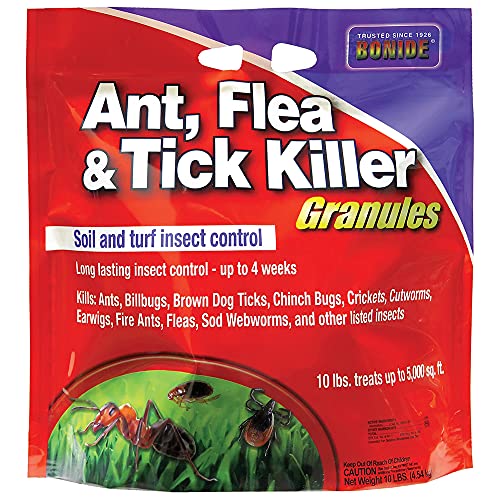
Bonide sits in the middle of the list nicely, because it gives you granules without the bulk of the larger Ortho bags. The ready-to-use pellets spread across lawn and garden spaces, and that makes it a comfortable fit for homeowners who want a simpler setup than spray mixing. Its listed four-week control window also helps with routine upkeep around foundations and grass edges. For many yards, that’s enough reach without feeling oversized.
The trade-off is coverage, since 10 lbs. treats up to 5,000 square feet, which is a smaller footprint than the larger bag options here. That smaller scale is fine for spot work, but you’ll notice the difference on a wide property. If your lawn is modest and you like a straightforward spreader routine, this lands in a very usable sweet spot.
Highlights
- Granules are ready to use, so you skip mixing and spraying.
- Works for lawn-wide application, foundation bands, or spot treatment, which gives you flexible placement.
- Targets fleas along with ants, ticks, fire ants, and several other listed insects.
- Up to four weeks of control fits regular maintenance cycles for smaller properties.
Areas To Watch
- Coverage is more limited than the larger 20,000 sq. ft. options.
- Granules need even spreading, so uneven passes can leave thin spots.
- The bag is still best kept dry and sealed, since moisture can affect flow through the spreader.
Core Details
Right Fit For
You’ll appreciate this most in a smaller yard where a lighter bag and a direct spread approach keep things simple.
Another Choice May Suit
Ortho BugClear Lawn Insect Killer 20 lb. is the better fit for larger lawns that need more reach in a single application.
Talstar One is the concentrate in this lineup, so it asks more from you but gives you more control over how much mix you put down. The bifenthrin formula, a synthetic pyrethroid used in outdoor pest control, points to a more traditional treatment approach than the natural-oil option from Cedarcide. That makes it a stronger fit for experienced homeowners managing persistent perimeter pressure or larger treatment routines. In a busy yard, concentrate can feel like the right tool, though it’s not the simplest one.
Compared with the ready-to-use sprays and granules above, this one rewards careful measuring and a little more prep. You’ll likely like it most when you already have a sprayer and want to manage a broader pest list from one jug. The honest read is that it suits people who are comfortable with more active mixing and cleanup.
Upsides
- Concentrate format lets you control mix strength and coverage planning.
- Covers fleas, ants, mosquitoes, spiders, and many more listed pests.
- Useful for perimeter work, which helps around the edge of the home and yard transitions.
- One gallon format suits larger treatment routines and fewer package changes.
Small Caveats
- Concentrates require measuring, mixing, and sprayer cleanup after use.
- More involved prep makes this less convenient than a ready-mix bottle or granules.
- Storage works best in a cool, tidy space where the cap stays secure.
Spec Overview
Who Should Grab It
This fits experienced homeowners who already use a sprayer and want a concentrate for broader outdoor control.
Swap It Out When
PetArmor Home Yard Spray for Dogs is the easier pick for lighter routine yard spraying with less mixing.
PetArmor feels built for the kind of yard maintenance that happens around pets, play areas, and quick touch-up jobs. The 32 oz bottle is easy to manage, and the format makes sense when you want a simple spray instead of a spreader-based routine. Compared with Talstar One, this is the friendlier pick for casual use, especially around a dog-focused household. It’s less about covering acres and more about keeping a familiar outdoor space under control.
The trade-off is that a smaller spray bottle won’t replace a large granular treatment on a wide property. Still, for regular upkeep around patios, paths, and the places pets wander, it fits naturally into weekly yard care. You may find it especially useful when you want a direct spray without extra mixing.
Reasons To Buy
- Spray format keeps application quick and familiar for basic yard upkeep.
- Targets fleas, ticks, mosquitoes, ants, and other listed bugs in one bottle.
- 32 oz size is easy to carry, store, and use for spot coverage.
- Works well for pet-centered outdoor spaces where routine touch-up matters.
Room For Improvement
- Smaller bottle size makes it less suited to broad lawn coverage.
- Spray use can take more passes than granules on larger yards.
- Nozzle care matters, because yard sprays can be messy after repeated use.
Details At A Glance
Whose Shelf It Belongs On
This belongs with households that want a straightforward pet-area yard spray and don’t need heavyweight coverage.
Look Elsewhere When
Ortho Lawn Insect Killer Granules 20 lbs. is the better call for larger lawns that need longer reach from a single treatment.
This Ortho bag is the long-haul option for yards that need season-minded control instead of a quick hit. It treats up to 20,000 sq. ft., which puts it in the same broad-coverage tier as the first Ortho pick, but with a longer stated residual window. That three-month outdoor control matters for homeowners who want fewer repeat applications across spring and summer. Compared with Bonide, it’s the more serious choice for a bigger lawn and a more stretched-out schedule.
The label also mentions use around flower and vegetable gardens, plus the home foundation, so the product works across several outdoor zones. You’ll still need a Scotts spreader, water-in step, and a dry-down period before people and pets re-enter treated areas. For a large yard, that extra structure is part of the value rather than a nuisance.
Best Bits
- 3-month residual control helps stretch treatment intervals through the season.
- 20,000 sq. ft. coverage fits broad lawns and larger outdoor spaces.
- Granule format supports even lawn distribution with the right spreader.
- Works above and below the ground, which broadens how the treatment reaches the yard.
Points To Note
- Requires a compatible Scotts spreader and water-in steps.
- Dry-down time means treated areas need a little planning before use.
- Dry storage helps protect the granules from clumping before application.
Feature Card
Built With In Mind
This suits larger yards that need longer-lasting granular control and a treatment plan you can repeat less often.
A Better Fit Elsewhere
Bonide Ant, Flea & Tick Killer Granules 10 lbs. is easier to handle for smaller lawns and lighter-duty coverage.
Ortho Bug B Gon has a preventive angle that makes it useful before pests become a bigger problem. The label points to early spring or summer application, so this is the kind of treatment you place before the yard starts looking rough. That proactive approach suits homeowners who like to stay ahead of flea pressure instead of reacting late. Compared with Ortho BugClear, it leans more into long-duration prevention than a fast-acting rescue feel.
It also covers lawns, ornamentals, home perimeter, and listed edibles, which gives you respectable range for a large property. The 20,000 sq. ft. treatment area keeps it in the same broad-coverage conversation as the larger Ortho bags. The main catch is timing, because this works best as part of an early-season routine rather than a last-minute fix.
Standout Traits
- Up to 3 months of control helps keep treatment plans spaced out.
- Early-use guidance fits homeowners who prefer prevention over reaction.
- Works on lawns, ornamentals, the perimeter, and listed vegetable crops.
- Broad pest coverage includes fleas, ants, ticks, chinch bugs, and more.
Softer Spots
- Best results depend on earlier application, so timing matters.
- Granule handling still asks for a spreader and dry storage.
- Its preventive focus can feel less immediate than a fast knockdown product.
Key Specs
The Right Fit
This works best for homeowners who want to get ahead of pest problems before the yard turns into a bigger chore.
Where Another Pick Suits Better
PetArmor Home Yard Spray for Dogs is the easier option for lighter, more immediate spray-based upkeep around pets.
Wondercide is the largest-format spray in the list, so it naturally suits yards that need more liquid treatment than a compact bottle can handle. The natural essential-oil angle overlaps a bit with Cedarcide, but the 128 oz size gives you a very different ownership experience. That extra volume helps in mixed yard-and-garden spaces where you want to keep spraying without stopping for refills. For regular maintenance, it feels like a steadier supply rather than a grab-and-go bottle.
It still asks for the same basic spray discipline as any concentrate, so you’ll want to think about storage, nozzle upkeep, and how often you’re covering broad areas. The pet-aware positioning also makes it an approachable option for homes that want a garden spray with a softer profile. In a yard with both open grass and planted areas, it fits cleanly into a practical routine.
Strong Points
- 128 oz size gives you a large spray supply for repeated yard use.
- Natural essential oils offer a gentler-feeling formula approach.
- Works in yard and garden spaces, which adds flexibility around landscaping.
- Targets fleas, ticks, mosquitoes, and other listed insects in one concentrate.
Honest Caveats
- Concentrate format still requires mixing or sprayer setup.
- Large bottle size can be awkward to store in a cramped shed.
- Sprayer care matters, because any concentrate benefits from clean nozzles and tight caps.
At A Glance
Who It Belongs On
This belongs on the shelf of a homeowner who wants a large, spray-based treatment for mixed yard and garden spaces.
Skip It When
Cedarcide YardSafe 1 Quart is a better fit for smaller touch-up jobs and more compact outdoor routines.
How To Choose The Right Flea Treatments For Lawns
Match The Format To The Yard
Granules suit bigger, open lawns because they spread evenly and often cover more ground with less hand labor. Sprays work better for smaller areas, fence lines, patios, and places you want to target more directly.
A concentrate gives you more control, but it asks for mixing and sprayer cleanup. Ready-to-use sprays are easier, though they usually make more sense for touch-up work than for broad properties.
Look Beyond Fleas Alone
Flea pressure rarely shows up by itself in a yard. Ticks, ants, mosquitoes, and lawn insects often overlap in the same spaces, so a broader pest label can save you from juggling several products.
That broader list matters most in pet-heavy yards, shaded corners, and fence edges where different pests tend to gather. A narrow flea-only spray can still help, but a broader formula often feels more practical for routine yard care.
Check Coverage And Reentry Needs
Coverage numbers help you judge whether one container fits your property or leaves you short. A 5,000 sq. ft. bag works well for modest lawns, while 20,000 sq. ft. coverage makes more sense for larger spaces.
Reentry instructions matter too, especially in yards used by kids or pets. Products that need watering in or drying time reward planning, while quick sprays offer more flexibility but less staying power.
Think About Your Routine, Not Just The Label
Some yards need a one-and-done seasonal plan, while others need lighter upkeep every few weeks. The best match is the one that fits your habits, your storage space, and how much setup you’ll realistically do.
For pet owners, the simpler bottle or spray format often gets used more consistently. For large properties, granules or concentrates usually make more sense because they stretch farther and reduce repeat shopping.
A Quick Reality Check
Wrong Turns To Avoid
Many shoppers focus only on the word flea and miss the rest of the pest list. That can leave you with a product that’s too narrow for a yard that also has ants, ticks, or lawn worms.
Another common miss is buying a format that doesn’t fit your routine. A spreader-only product can feel clumsy in a small yard, while a tiny spray bottle gets old fast on a bigger property.
The Upgrade Payoff
Higher-tier options in this category usually cost more because they carry larger volumes, broader coverage, or longer residual control. Concentrates also tend to ask more of you, but they give back flexibility in how much area you treat and how often you refill.
That extra spend makes the most sense for larger properties, mixed yard-and-garden setups, or anyone who wants fewer treatments across the season. For a small patio or one problem corner, a simpler bottle is often enough.
Frequently Asked Questions
Are Granules Better Than Sprays For Lawn Fleas?
Granules usually suit larger lawns because they spread farther and can offer longer residual control. Sprays fit smaller, more targeted jobs and are easier to handle for quick touch-ups.
Do You Need A Spreader For Every Lawn Treatment?
No, only the granule products call for a spreader. Spray products and concentrates use a bottle or sprayer instead.
Can One Product Handle Fleas And Other Yard Pests?
Yes, several of the picks cover fleas along with ants, ticks, mosquitoes, or other listed insects. That broader coverage helps in yards with mixed pest pressure.
What Size Yard Fits A Smaller Bag Or Bottle?
A smaller bag around 5,000 sq. ft. coverage suits modest lawns and focused treatment areas. Compact spray bottles work better for spot treatment than for full-property coverage.
Should You Choose Natural Oils Or A Traditional Formula?
Natural-oil sprays suit homeowners who want a lighter-feeling format and a more flexible routine. Traditional concentrates and granules usually make more sense for broader coverage and longer outdoor control.
Closing Thoughts
Your best flea treatment depends on how much yard you manage and how much setup you’re willing to handle. Ortho’s large granular options make sense for wide lawns, Cedarcide and Wondercide lean lighter and more flexible, and Talstar One serves the hands-on applicator who wants a concentrate. Bonide and PetArmor fill useful middle ground for smaller jobs and routine upkeep. Pick the format that fits your yard habits, and the rest gets a lot easier.
