A fern, pothos, and flowering begonia can share a windowsill, yet each may need a different kind of nutrition. I focus on fertilizer for houseplants by plant type, application format, concentrate strength, and indoor fit, helping plant owners match the right option to their collection without treating every pot the same.
Nature’s Source handles the broadest indoor collection in this group. Its 10-4-3 formula combines nitrogen, phosphorus, and potassium in a general-purpose plant food, while the oilseed-derived extract gives the concentrate a defined source.
A concentrated fertilizer provides nutrients in a small pre-use volume, which makes measured dilution easier and storage more economical. Compared with Miracle-Gro Orchid Plant Food Mist, it suits mixed foliage collections rather than a single specialized plant type.
A Strong Showing
✓Works with both indoor and outdoor plants.
✓The 10-4-3 ratio supports a broad range of foliage and flowering plants.
✓One teaspoon per gallon simplifies dilution for houseplants.
✓The 64 oz container reduces refill frequency for larger collections.
Trade Offs
•Its general-purpose formula is less targeted than the azalea or orchid options.
•The 64 oz size needs more storage space than an 8 oz container.
Key Specs
Feature
Specification
Why It Matters
Nutrient ratio
10-4-3
Provides a broad balance of nitrogen, phosphorus, and potassium.
Material
Oilseed-derived extract
Defines the concentrate’s plant-food base.
Houseplant dilution
1 teaspoon per gallon
Supplies a measured amount for standard indoor watering.
Garden dilution
1 tablespoon per gallon
Scales the same concentrate for outdoor beds and landscapes.
Package size
64 oz
Suits frequent feeding across several plants.
Made For
This fits plant owners with mixed foliage and flowering houseplants who want one adaptable concentrate for indoor and outdoor use.
A Better Fit Elsewhere
Orchid specialists will find Miracle-Gro Orchid Plant Food Mist more directly aligned with a collection dominated by orchids.
Miracle-Gro’s azalea, camellia, and rhododendron food is the focused option for acid-loving plants. Its water-soluble format fits routine watering, and the named plant list extends beyond those three headline varieties to gardenias, hibiscus, hollies, hydrangeas, and orchids.
Unlike Nature’s Source 10-4-3 Plant Food, this selection makes the plant category the central decision. A windowsill filled with rhododendrons and hydrangeas gives it a more logical role than a general-purpose concentrate, depending on the rest of the collection.
Standout Benefits
✓Formulated for a specific group of acid-loving plants.
✓Water-soluble format integrates with regular watering.
✓The plant list includes familiar indoor and patio varieties.
Worth Noting
•The 5 lb package requires more storage space than the 8 oz houseplant option.
Quick Facts
Feature
Specification
Why It Matters
Format
Water-soluble plant food
Supports use during routine watering.
Package size
5 lb
Provides a larger supply for established collections.
Named plants
Azaleas, camellias, rhododendrons, gardenias, hibiscus, hollies, hydrangeas, and orchids
Helps identify compatibility before application.
Who Will Love This
This serves plant owners with a meaningful collection of acid-loving blooms, especially rhododendrons, azaleas, hydrangeas, or orchids.
Consider Something Else When
Owners of mostly tropical foliage plants will find Organic Plant Magic All-Purpose Plant Food more broadly aligned with a mixed indoor collection.
Miracle-Gro LiquaFeed focuses on flowering plants, giving it a distinct role during the active growing and blooming period. A liquid plant food delivers nutrients in liquid form, while the Bloom Booster name makes its intended category clear.
Compared with Miracle-Gro’s acid-loving plant food, this option is organized around flowers rather than soil preference. That distinction matters in a windowsill containing begonias, geraniums, and African violets, although a mixed collection may still favor a broader all-purpose formula.
What Works In Its Favor
✓Its flower-specific positioning is easy to match to blooming houseplants.
✓The liquid format offers a distinct option for a plant collection centered on flowers.
Points To Note
•I would confirm plant compatibility on the label before using it across a varied collection.
•Liquid plant food can add an application step compared with a ready-to-use mist.
Right Fit For
This matches plant owners whose indoor collection emphasizes flowering specimens and a seasonal routine centered on blooms.
Where Another Pick Suits Better
A collection dominated by broad-leaved tropical plants is better served by Smart Grower Genius+ Houseplant Food.
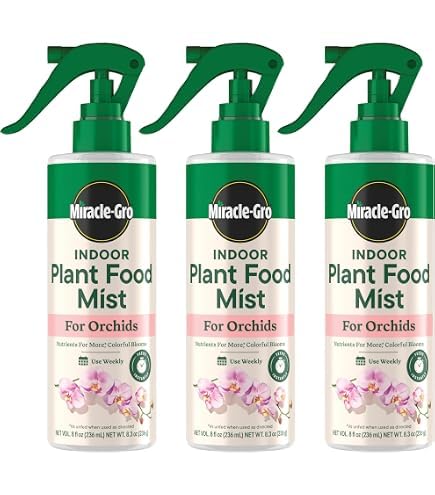
A mist bottle makes orchid care refreshingly direct. Miracle-Gro’s ready-to-use Orchid Plant Food Mist combines plant food and liquid application, removing the separate dilution step that comes with many concentrated houseplant products.
The source directions call for spraying leaves, roots, and growing media once per week while avoiding the flowers. That routine makes the format especially relevant for orchid owners with several pots, unlike Miracle-Gro LiquaFeed Bloom Booster Flower Food, which is positioned more broadly toward flowering plants.
Practical Pluses
✓Ready-to-use mist simplifies application.
✓Designed specifically for orchid foliage, roots, and growing media.
✓Combines moisture and nutrition in one weekly step.
✓Three bottles support multiple orchid pots.
✓Each bottle holds approximately 8 fl oz.
Small Caveats
•The flowers should be avoided during application, which requires a careful spraying technique.
Feature Snapshot
Feature
Specification
Why It Matters
Format
Ready-to-use plant food mist
Combines nutrition with direct liquid application.
Order quantity
3 bottles
Allows distribution across several orchid pots.
Bottle volume
Approximately 8 fl oz each
Provides a compact supply for a dedicated orchid collection.
Suggested frequency
Once per week
Fits neatly into a recurring plant-care routine.
Application area
Leaves, roots, and growing media
Covers the main plant and root-zone surfaces.
Built With In Mind
This suits orchid enthusiasts who prefer a compact, ready-to-use feeding routine and want a dedicated product for several pots.
Reach For A Different Pick When
Plant owners with mixed tropical foliage will find Nature’s Source 10-4-3 Plant Food more adaptable across species.
Mycorrhizal fungi form close associations with plant roots, which is the central idea behind Smart Grower’s root enhancer. This product uses five strains rather than a single-strain approach, giving root-focused plant care a more layered formulation.
Unlike Organic Plant Magic All-Purpose Plant Food, this is a specialist amendment centered on the root zone rather than a broad all-purpose feeding program. The 125-gram package also provides a stated capacity for 125 plants, making plant count a practical part of the purchasing decision.
A Few Highlights
✓Five fungal strains provide formulation diversity.
✓The 125-gram package is sized for a stated 125-plant capacity.
✓A 100-spore-per-gram figure offers a concrete formulation detail.
Practical Considerations
•Root-enhancer positioning is narrower than a general houseplant food.
•Plant count and pot size should guide the application amount.
•I would keep this separate from a general feeding routine unless the label calls for combined use.
Whose Shelf It Belongs On
This fits hobbyists who want a dedicated mycorrhizal root product and understand the label’s application method.
Look Elsewhere When
Owners seeking a straightforward general fertilizer will find Nature’s Source 10-4-3 Plant Food easier to categorize.
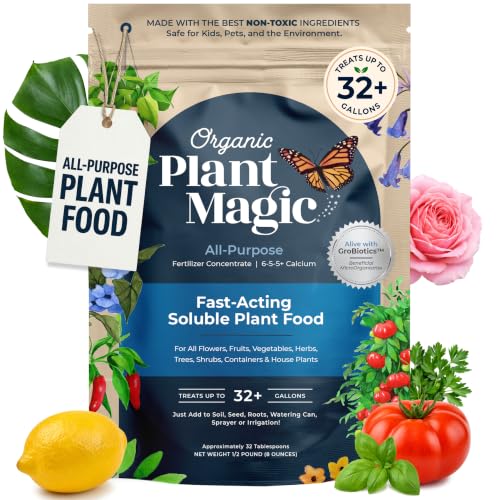
Organic Plant Magic extends beyond the windowsill without splitting the routine into separate indoor and outdoor products. The water-soluble concentrate covers vegetables, flowers, herbs, fruit, trees, gardens, and houseplants, which makes it useful for a varied property.
One half-pound bag makes more than 32 gallons of liquid plant food, giving the concentrate an impressive reach for frequent feeding. Compared with Smart Grower 5-Strain Mycorrhizal Root Enhancer, it occupies the broader nutritional role rather than focusing solely on root associations.
Good Reasons To Consider
✓Serves a wide range of indoor and outdoor plant categories.
Smart Grower Genius+ is designed around the conditions plants actually encounter indoors, rather than borrowing lawn-care positioning. Its stated role includes supporting roots, foliage, and growth in houseplants, tropicals, and other potted greenery.
The 8 oz size is the practical distinction here. It takes less shelf space than Nature’s Source 10-4-3 Plant Food or Organic Plant Magic All-Purpose Plant Food, making it a sensible choice for apartments, studio shelves, and collections with limited storage.
Features That Help
✓Formulated specifically for indoor houseplants.
✓The 8 oz container is easy to store in an apartment.
✓Its stated coverage includes tropicals and everyday potted plants.
Less Ideal Details
•The indoor focus makes it less suitable for outdoor beds and landscapes.
•Plant-specific products may align more closely with orchids or acid-loving species.
The Right Fit
This fits apartment dwellers and indoor plant enthusiasts who value a compact, houseplant-specific package.
Swap It Out When
Gardeners maintaining flowers, herbs, and outdoor beds will find Organic Plant Magic All-Purpose Plant Food more versatile.
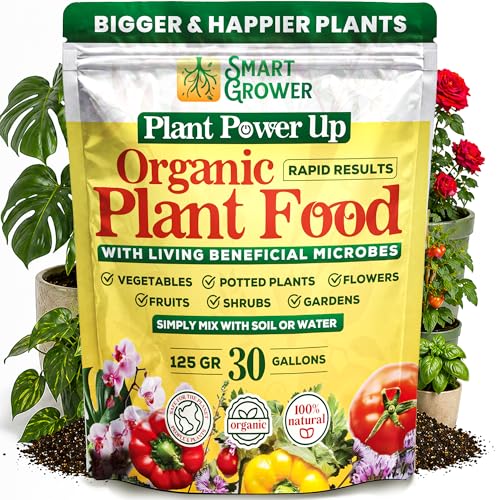
Smart Grower combines organic plant nutrients with beneficial microbes, adding a biological element to the usual fertilizer decision. Beneficial microbes are microorganisms included to support the soil-side environment around plant roots.
The 125-gram package makes 30 gallons of prepared plant food, placing it between a smaller indoor bottle and a larger general-purpose supply. Compared with Smart Grower 5-Strain Mycorrhizal Root Enhancer, it combines plant nutrition with microbes rather than concentrating on fungal root associations alone.
Real Benefits
✓Combines organic plant food with beneficial microbes.
✓Produces 30 gallons of prepared plant food.
✓Works for houseplants and outdoor gardens.
✓The 125-gram package offers a manageable storage size.
✓Its broader use suits mixed indoor and outdoor routines.
Details To Watch
•The label’s dilution and application directions should govern the prepared amount.
Feature Facts
Feature
Specification
Why It Matters
Package weight
125 g
Offers a compact supply for repeated use.
Prepared volume
30 gallons
Supports regular feeding across multiple plants.
Plant food type
Organic plant food
Provides a plant-focused nutrition option.
Added component
Beneficial microbes
Adds a biological element to the root-zone routine.
Made For
This fits organic-focused plant owners who want beneficial microbes included in a food suitable for indoor and outdoor collections.
Another Choice May Suit
Those prioritizing a specialized fungal root enhancer will find Smart Grower 5-Strain Mycorrhizal Root Enhancer more closely aligned.
## Choosing by Plant Type and Plant-Care Routine
### Match the Formula to the Collection
A broad collection benefits from an all-purpose food such as Nature’s Source 10-4-3 Plant Food. Acid-loving species point toward Miracle-Gro’s azalea, camellia, and rhododendron formula, while flowering houseplants make a flower-focused liquid option more relevant.
### Distinguish Concentrates From Ready-to-Use Products
A concentrate requires measurement before watering, which can make a large package economical across many pots. Miracle-Gro Orchid Plant Food Mist takes the opposite approach, with a ready-to-use spray that suits a small, specialized orchid collection.
### Check Plant Compatibility Before Dilution
Labels can distinguish general foliage, flowering, acid-loving, and indoor plants. I also compare the package size with the number of pots, since a large outdoor supply may be unnecessary for a single windowsill.
### Account for Storage and Routine
A 5 lb or 64 oz container needs more shelf space than an 8 oz package. Concentrates also need accurate measurement, while mist formats call for careful application around flowers and other sensitive plant parts.
## Practical Details That Change the Choice
### Common Shopping Slip Ups
The most common mistake is treating every houseplant as a lawn plant. Another is choosing by the largest package without considering storage, dilution, or plant compatibility. I check the target plant list before focusing on package size.
### What Separates Premium From Basic
A specialized formulation may cost more because it targets a narrower plant group or adds a distinct feature such as microbes. The extra spending makes sense only when that feature matches the collection and the application routine feels manageable.
## Frequently Asked Questions
### Can one fertilizer feed all houseplants?
General-purpose food can cover many mixed collections, though orchids and acid-loving plants may benefit from specialized formulas. I compare the label’s plant list with the plants already on the shelf.
### Is liquid fertilizer better than dry fertilizer for houseplants?
Neither format is inherently better; convenience and plant fit matter more. Liquid products can simplify application, while dry concentrates often provide more prepared feed per package.
### How often should houseplants be fertilized?
Feeding frequency depends on the plant, growing season, and product label. I avoid automatically increasing the amount, since over-concentration can place unnecessary stress on roots.
### Can houseplant fertilizer be used outside?
Products labeled for both indoor and outdoor plants can cover more than one part of the property. I keep separate products for specialized indoor needs, such as an orchid mist, in a separate cabinet.
### Should fertilizer be used on drooping or discolored leaves?
Color and posture can reflect watering, light, pests, or several other conditions. I check the plant’s broader condition and the fertilizer label before treating discoloration as a simple nutrient issue.
## Final Verdict
Nature’s Source 10-4-3 Plant Food is my most versatile starting point for a mixed collection, while the orchid mist and flower formulas serve clearly defined plant groups. I would match package size to the number of plants, confirm compatibility, and keep application directions close at hand. A thoughtful match is more useful than keeping several bottles open.