Cutting a wide lawn should not require constant fuel stops, tangled charging cables, or a machine too large for the property. I see three distinct needs in this lineup: seated control for large acreage, compact battery storage, and robotic mowing with little or no hands-on operation. The Ariens Edge provides a gasoline zero-turn baseline, while the Greenworks riders and robotic Mowrator, MOVA, and YARBO machines cover the electric side. The deciding factors are deck size, terrain, battery logistics, and how much direct control is useful.
The gasoline-powered Ariens Edge 915283 brings a conventional zero-turn layout to a category otherwise dominated by batteries and robotic platforms. Its 20-horsepower Briggs & Stratton EXi2000 engine and 42-inch deck suit broad, relatively open lawns where a larger cutting pass reduces the number of trips.
Unlike the robotic models later in the lineup, this mower requires active operation. A Hydro-Gear EZT transmission handles speed and direction through a hydrostatic system, which uses fluid flow to vary drive output, and the stated ground speeds reach 6 mph forward or 3 mph in reverse.
Where It Excels
✓The 42-inch fabricated deck provides a wide cutting area.
✓The 20HP engine offers strong power for demanding grass.
✓Hydrostatic control supports smooth speed changes.
✓Reverse travel makes backing away from obstacles easier.
Trade Offs
•Gasoline storage and engine upkeep do not suit an electric-only storage plan.
•The 42-inch deck is less compact than the 21-inch robotic models.
At A Glance
Feature
Specification
Why It Matters
Engine
20HP Briggs & Stratton EXi2000
Provides conventional power for dense grass.
Deck
42-inch, two-blade fabricated design
Covers more ground per pass.
Transmission
Hydro-Gear EZT hydrostatic system
Provides controlled speed variation.
Ground speed
6 mph forward, 3 mph reverse
Balances mowing pace with maneuvering.
Made For
Large-property owners who prefer seated zero-turn control and do not require battery-only operation.
A Better Fit Elsewhere
The Greenworks PRO 80V 42-Inch Electric Lawn Tractor suits households that require a 42-inch electric platform instead of a gasoline engine.
Remote control changes the practical limits of a robotic mower, particularly on steep ground where a seated operator may prefer not to climb. The Mowrator S1 4WD combines a 21-inch cutting deck with four-wheel drive, an 18Ah battery, and a stated incline capability of 37 degrees.
That makes it more hands-on than the fully automated MOVA and YARBO options, but it also provides direct control around narrow paths or confined lawn areas. Compared with the Ariens Edge, the S1 is smaller and quieter by design, though it lacks a broad conventional riding deck.
Notable Gains
✓Four-wheel drive supports operation on slopes rated to 37 degrees.
✓Remote control keeps the operator away from moving blades.
✓The 18Ah battery gives this S1 more nominal capacity than the 12Ah version.
✓Optional tow, mulching, and snow-clearing attachments extend seasonal use.
Small Caveats
•The seasonal attachments are optional rather than part of the core mowing package.
•The 21-inch deck requires more passes than the 42-inch and 54-inch riders.
Who Will Love This
Sloped-yard households that value remote steering and want one platform to handle mowing, towing, mulching, and snow removal.
Another Choice May Suit
The Mowrator S1 4WD 12Ah Remote Lawn Mower fits a compact storage plan where battery capacity matters less than remote slope control.
The MaximusZ brings the widest deck in this selection to an electric zero-turn platform. Its 54-inch cutting width targets expansive, mostly level properties where minimizing passes matters more than compact storage. The 60V system also brings the electric format to a substantial seated machine rather than a compact robot.
The package includes two 20Ah suitcase batteries, four 8Ah batteries, and a fast charger. That inventory can sustain demanding work, but six removable packs create more charging and storage logistics than the smaller battery arrangements used by the robotic models.
The Helpful Details
✓The 54-inch deck reduces passes across large lawns.
✓Six batteries provide several options for power rotation.
✓The zero-turn layout suits maneuvering around landscape features.
✓Electric operation removes gasoline storage from the lawn area.
Practical Considerations
•Six batteries and a large deck require dedicated storage space.
•The 54-inch width is less convenient around tight access routes.
Quick Facts
Feature
Specification
Why It Matters
Voltage
60V
Defines the electric platform.
Deck
54 inches
Cuts a wide swath per pass.
Batteries
Two 20Ah and four 8Ah packs
Supports rotation and charging planning.
The Right Fit
Owners of expansive, relatively flat properties who want a wide electric rider and can manage several batteries.
Consider Something Else When
The Greenworks PRO 80V 42-Inch Electric Lawn Tractor suits a narrower 42-inch footprint and a smaller battery collection.
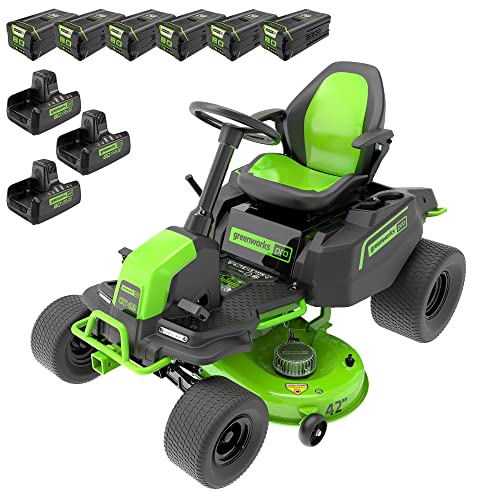
Where the MaximusZ prioritizes a 54-inch deck, this Greenworks PRO model balances a 42-inch cutting width with a more substantial battery and charging package. Its 80V system includes six 5Ah batteries and three dual-port turbo chargers, giving a large property several ways to keep productive mowing time.
The tractor-style platform is more familiar than a robotic mower, with a high-back padded seat, back support, and folding armrests. Brushless motor technology is rated for mowing up to two acres on one charge, making this a practical seated electric choice for extensive lawns.
A Favorable Mix
✓Six 5Ah batteries support extended mowing sessions.
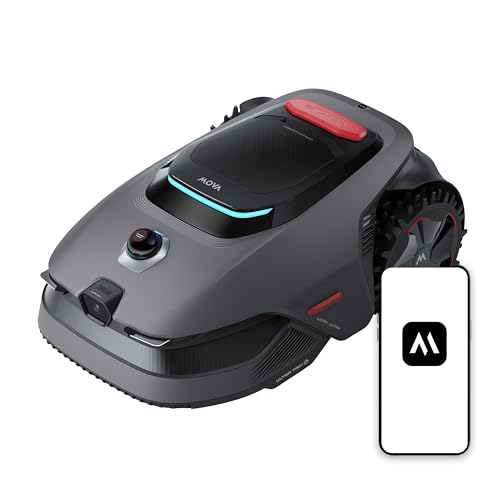
The LiDAX Ultra 1000 uses 360-degree 3D LiDAR and AI-assisted vision to map a lawn without a boundary wire. LiDAR measures surroundings with laser-based sensing, while the vision system adds visual obstacle recognition. For a quarter-acre property, that combination offers detailed mapping without the digging and perimeter setup associated with wire-guided robots.
Its edge-cutting function, adjustable 1.2-to-3.9-inch cutting height, and 150 managed zones provide detailed control for residential lawns. The included garage gives the mower a protected home, although it ships separately from the main unit and requires space for both components.
Strengths Worth Knowing
✓3D LiDAR supports detailed property mapping.
✓AI vision adds a second layer of obstacle detection.
✓Edge cutting helps the deck work close to boundaries.
✓The cutting height adjusts across a broad range.
✓Managed zones allow separate lawn areas.
Details To Watch
•The quarter-acre designation is smaller than the 0.5-acre LiDAX Ultra 2000.
•The garage and mower arrive as separate components.
Feature Card
Feature
Specification
Why It Matters
Lawn size
Up to one-quarter acre
Targets compact residential yards.
Mapping
3D LiDAR and AI vision
Detects lawn shape and obstacles.
Cutting height
1.2 to 3.9 inches
Accommodates different grass lengths.
Slope rating
45 percent
Supports moderately inclined lawns.
Who Should Grab It
Residential owners with a quarter-acre lawn who want detailed wireless mapping, edge control, and a protected mower garage.
Look Elsewhere When
The MOVA LiDAX Ultra 2000 0.5-Acre Robotic Mower with Blade Kit suits a larger half-acre property and 4G-equipped setup.
The YARBO system extends beyond a single-purpose robotic mower by accepting interchangeable modules for mowing and leaf blowing. Its tracked chassis, stated 6.2-acre coverage, and 70-percent slope rating position it for expansive terrain where conventional robotic wheels may struggle. Obstacle detection adds another layer of protection around gardens and yard fixtures.
Compared with the MOVA LiDAX Ultra 1000, YARBO covers more ground and handles a broader range of seasonal tasks, though it requires additional modules for some functions. The snow-blower module is separate, so a complete winter setup involves more than the core mowing and leaf-blowing package.
Useful Strengths
✓Interchangeable modules handle mowing and leaf blowing.
✓Tracked drive supports the stated 70-percent slope rating.
✓Coverage extends to 6.2 acres.
✓Obstacle detection helps protect the machine and landscaping.
Factors To Consider
•The snow module is sold separately.
•Different attachments require storage space and setup changes.
Core Details
Feature
Specification
Why It Matters
Coverage
6.2 acres
Targets a large yard in one system.
Slope rating
70 percent
Supports demanding terrain.
Whose Shelf It Belongs On
Large-property households that want tracked robotic mowing and leaf blowing from a modular platform.
Swap It Out When
The Mowrator S1 4WD 18Ah Remote Lawn Mower suits a more compact setup centered on remote mowing and optional seasonal attachments.
The LiDAX Ultra 2000 scales the LiDAX concept from a quarter-acre lawn to a half-acre property while adding 4G hardware. Its 360-degree 3D LiDAR and AI vision mapping handle complex layouts without a boundary wire, and the edge-cutting system is designed for close perimeter work in gardens or along paths.
The cutting height remains adjustable from 1.2 to 3.9 inches, with 150 managed zones for separating different lawn sections. Compared with the LiDAX Ultra 1000, the larger acreage rating and 4G component suit a broader site, but the included blade kit ships separately and must be accounted for during setup.
What Helps Most
✓Half-acre coverage suits a larger residential lawn.
✓4G hardware expands the connected configuration.
✓LiDAR and vision create a detailed property map.
✓Edge cutting improves work near hard boundaries.
✓A wide cutting-height range accommodates changing grass conditions.
Where It May Fall Short
•The separate blade kit requires an additional setup check.
•The 45-percent slope rating is lower than the YARBO system.
Best Suited To
Half-acre residential properties needing wireless mapping, cellular hardware, and detailed zone control.
Where A Sibling Pick Shines
The MOVA LiDAX Ultra 1000 1/4-Acre Robotic Mower with Garage fits a smaller quarter-acre lawn and includes a protected parking structure.
The 12Ah Mowrator S1 retains the useful core of the 18Ah version: four-wheel drive, remote steering, a 21-inch deck, and a 37-degree slope rating. That makes it a credible choice for a compact or sharply inclined yard where a larger riding mower would be cumbersome. The lower battery capacity is the main point of comparison with its larger sibling.
For frequent mowing across a broad property, the 18Ah model offers the more comfortable capacity margin. The 12Ah version appears better aligned to smaller areas or limited battery storage, especially when a tow hitch, mulching blade, or snow plow is added later.
Practical Advantages
✓Remote control separates the operator from the cutting deck.
✓Four-wheel drive supports the stated 37-degree incline.
✓The 21-inch deck fits confined access better than a wide rider.
Some Limits To Know
•The 12Ah battery has less nominal capacity than the 18Ah S1.
## What Actually Matters in an Electric Lawn Setup
### Deck width and turning space
A wider deck reduces the number of passes across an open lawn, but it also makes gates, paths, and storage areas harder to navigate. The 54-inch Greenworks MaximusZ suits expansive properties, while the 21-inch Mowrator S1 fits more confined terrain. Zero-turn-style steering helps with obstacles, though a robotic platform relies on automated navigation instead of a seated operator.
### Battery quantity is only half the calculation
Capacity matters, but charging speed, charger count, and storage space shape daily use as well. The Greenworks MaximusZ includes six batteries, the Greenworks PRO tractor includes six smaller packs, and the Mowrator S1 uses a single integrated 12Ah or 18Ah battery. I would compare the complete battery collection, not just one pack, before settling on a rider.
### Robotic mapping versus direct control
LiDAR creates a spatial map by measuring surroundings with laser-based sensing, while AI vision adds object recognition. That autonomy is useful for routine mowing on a quarter-acre or half-acre lawn. Remote-controlled models provide a more immediate response on difficult terrain, although an operator must remain involved.
### Terrain and attachments
Slope ratings create a clear dividing line among the robotic options. The YARBO system supports 70-percent slopes, while the MOVA models carry 45-percent ratings and the Mowrator S1 reaches 37 degrees. Optional mulching, towing, and snow modules broaden seasonal use, but they also increase cost, storage, and setup requirements.
## Avoidable Errors Before the Purchase
### Mistakes Worth Dodging
A large deck does not automatically suit a large lawn. Narrow access paths, steep areas, and tight turns can negate the benefit of covering more ground in one pass. I would map the route from storage to the lawn and note every pinch point before choosing deck width.
### Why the Larger Package Costs More
Additional batteries, multiple chargers, garages, and interchangeable modules account for much of the spending difference. Those components help when mowing time, charging logistics, or seasonal tasks justify the added equipment. A smaller setup remains more practical for modest lawns and limited storage.
## Frequently Asked Questions for Electric Zero Turn Mower
### Can an electric zero turn mower handle a large lawn?
Yes, provided the deck width, battery arrangement, and terrain match the property. The Greenworks MaximusZ and PRO tractor cover more ground per pass than the 21-inch robotic models.
### What is the difference between a riding mower and a robotic mower?
A riding mower places the operator in a seat with direct steering control. A robotic mower maps and navigates the lawn with minimal or no hands-on operation.
### How does LiDAR mapping differ from RTK positioning?
LiDAR maps nearby physical features with laser-based sensing and can identify obstacles. RTK positioning uses satellite reference signals to determine a more precise position.
### Do robotic lawn mowers need a boundary wire?
Models using LiDAR and vision mapping can operate without one. A boundary wire remains relevant for other robot systems that rely on a buried signal to define the mowing area.
### How much battery storage should I plan for?
Storage should accommodate every battery, charger, and the mower itself without crowding the charging area. A six-battery package needs considerably more room than a single integrated battery.
## Bottom Line
The right machine depends on the yard rather than the label alone. I favor the Ariens Edge for a wide gasoline zero-turn platform, the Greenworks models for seated electric mowing, and the MOVA robots for mapped quarter-acre and half-acre lawns. The YARBO system stands apart for modular, large-property yard care, while the Mowrator S1 serves remote control on demanding slopes.