A lawn can look sparse because poor seed selection, incompatible weather conditions, or damaged turf created the problem, not simply a lack of seed. This guide covers warm-season plug options, transition-zone tall fescue, winter ryegrass, and combined seed-and-fertilizer formulas to help you select grass suited to your lawn’s actual conditions.
For a coastal yard, Florida Foliage Floratam offers a direct alternative to broadcasting Bermuda seed. These live St. Augustine plugs establish through vegetative propagation, meaning rooted plant sections are planted instead of germinating from seed, which gives you an immediate head start on filling bare ground.
Floratam produces wide, long leaf blades and purplish-red stolons, the horizontal stems that spread across the soil. Its coarse texture is most visible up close, yet forms a substantial residential lawn in warm coastal conditions.
The Case For It
✓Live plugs bypass the germination stage, making them practical for substantial lawn sections.
✓Large, spreading stolons can knit bare ground into a dense turf over time.
✓Salt, drought, and shade tolerance suit exposed southern lawns.
Points To Keep In Mind
•This is St. Augustine sod, not Bermuda grass seed, so it changes the lawn’s species and mowing needs.
•New plugs require close irrigation during establishment, including several short watering periods daily.
Key Specs
Feature
Specification
Why It Matters
Propagation
18 live sod plugs
Supports direct planting without seed germination.
Grass type
St. Augustine Floratam
Suits warm coastal environments.
Stolon internodes
Average 3 inches
Reflects the grass’s spreading growth habit.
Suggested mowing height
Up to 1.5 inches
Helps retain the dense, coarse-textured appearance.
Made For Coastal Lawns
This option fits homeowners in warm coastal regions who want coarse St. Augustine turf and can follow a deliberate plug-watering schedule.
Another Choice May Suit
Lawn Synergy Lesco All-Pro Transition Tall Fescue suits larger lawns in regions with hot summers and cool winters.
Large properties in transition zones need a cool-season grass that can handle both warm summers and cold winters. Lawn Synergy Lesco All-Pro uses a tall fescue blend suited to that changing climate, while its 50-pound format offers useful coverage for substantial yards or professional-scale reseeding.
For overseeding, the stated rate covers up to 10,000 square feet at 5 pounds per 1,000 square feet. A new lawn requires more seed, with coverage reaching 6,250 square feet at 8 to 10 pounds per 1,000 square feet.
Standout Benefits
✓Heat, drought, and moderate-shade tolerance suits variable seasonal conditions.
✓Endophyte-enhanced grass contains naturally occurring fungi that discourage surface-feeding insects.
✓The tall fescue blend is designed for mowing, durability, and dense dark-green turf.
✓Traffic tolerance makes it practical around active residential walkways.
Where It May Fall Short
•The 50-pound bag requires substantial storage and careful planning for application rates.
•It is a tall fescue alternative, not a Bermuda-specific blend for warm-season lawns.
•Traffic tolerance does not eliminate the need for a properly prepared seedbed and consistent watering.
Who Will Love This
Homeowners managing a large lawn in a transition zone benefit most from the broad coverage and seasonal tolerance.
A Better Fit Elsewhere
Barenbrug Wonderlawn Winter Mix is a stronger fit for a temporary cool-season lawn planted during late fall.
Late-season color is the goal for many southern lawns, and Barenbrug Wonderlawn Winter Mix focuses on that job. Its turf-type Italian and perennial ryegrass blend is suited to sunny and partially shaded locations where winter conditions can slow a warm-season lawn.
The listed germination window is 7 to 12 days, making this a seasonal option rather than a long-term Bermuda substitute. The best planting window is late fall through early winter, particularly when soil temperatures sit in the mid-40s.
Real Benefits
✓Ryegrass provides cool-season coverage during months when Bermuda may lose color.
✓The blend tolerates both partial shade and open sun.
✓A stated 7-to-12-day germination period suits timely fall renovation work.
✓The 5-pound bag is more manageable than a large professional sack.
Trade Offs
•Winter grass serves a seasonal purpose and does not replace a permanent Bermuda lawn.
•Planting outside cool soil conditions can reduce the usefulness of the quick-germination claim.
•Partially shaded sites still require adequate light and moisture for dependable turf growth.
The Right Fit
This mix fits southern homeowners seeking temporary winter color rather than year-round warm-season turf.
Where A Sibling Pick Shines
Florida Foliage Floratam 3 Inch Sod Plugs better serves coastal yards seeking permanent, spreading St. Augustine turf.
Scotts Turf Builder Grass Seed takes a practical approach by pairing seed with lawn-establishment nutrition. Its Root-Building Nutrition formula combines ingredients intended to support deeper rooting and thicker green turf, while the 5.6-pound package provides a practical amount for a residential lawn.
The sun-and-shade positioning makes this a useful option for yards containing trees, buildings, and open areas. Compared with the much larger Lesco blend, it requires less material to store, though coverage still depends on the treated area and the label’s application rate.
Reasons It Performs
✓Combines grass seed, fertilizer, and soil improver to reduce the number of materials needed during establishment.
✓Root-focused nutrition supports the development of a denser lawn.
✓The sun-and-shade mix suits lawns with changing light exposure.
✓The 5.6-pound container balances residential use with manageable storage.
Details To Watch
•Using the product on a large property may require several containers.
•Nutrition accelerates establishment only when proper watering and care follow planting.
•The mix is a general sun-and-shade formula, not a documented Bermuda-specific blend.
Built With In Mind
This option suits homeowners who want a combined seed-and-nutrition approach for a mixed-light residential lawn.
Reach For A Different Pick
Scotts Rapid Grass Sun & Shade 2.4 lbs makes more sense for a concentrated repair with faster establishment as the priority.
Thin patches and small bare areas call for a focused repair product rather than a full-lawn reseed. Scotts Rapid Grass Sun & Shade combines seed with fertilizer, and its listing says the grass can grow up to twice as fast as seed alone when applied at the new-lawn rate and properly cared for.
The formula is intended for both new grass and overseeding, with spring or fall planting favored. The listed 2.4-pound pack is particularly convenient for storing and carrying only the amount needed for smaller projects.
What Earns Its Place
✓The combined seed-and-fertilizer formula targets faster visible establishment.
✓Works for both new planting and thinning lawns.
✓Sun-and-shade positioning broadens the range of usable planting areas.
✓The smaller pack is easier to store than the 50-pound Lesco option.
Small Caveats
•The faster-growth result depends on proper care and the listed application rate.
•Multiple packs may be necessary for a larger lawn.
•Sun-and-shade suitability does not make the mix suitable for every grass species or climate.
Who Should Grab It
This product fits homeowners repairing limited bare areas during spring or fall and wanting seed and nutrition in one purchase.
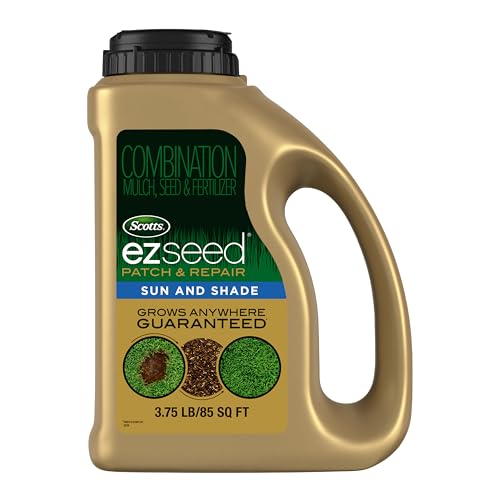
For bare patches beneath trees, worn areas, and slopes where seed can wash away, Scotts EZ Seed Patch & Repair offers a targeted approach. Its formula combines grass seed with continuous-release lawn food and super-absorbent growth granules, which help the treated area retain moisture during establishment.
The product is designed for full sun, dense shade, high-traffic locations, and slopes. That range makes it useful for a mixed lawn, though dense shade can still be difficult because the available light sets a hard limit on grass growth.
Where It Excels
✓Targets the specific problem of filling bare or damaged patches.
✓Super-absorbent granules support moisture around the seeded area.
✓Continuous-release lawn food supports the new grass as it establishes.
✓Handles full sun, shade, traffic, and sloped locations in one formula.
Less Ideal Details
•The product solves localized damage rather than whole-lawn overseeding needs.
•Dense shade may produce limited growth even with moisture support.
•Sloped sites still need careful preparation to limit seed movement.
Whose Shelf It Belongs On
This option fits homeowners with isolated bare spots, shaded corners, worn paths, or small slopes that need concentrated repair.
Consider Something Else When
Scotts Turf Builder Grass Seed 5.6 lbs makes more sense when establishing a broader area of mixed sun-and-shade turf.
## What Matters Before You Buy Lawn Seed
### Match The Grass To The Climate
Bermuda is a warm-season grass, so its strongest fit is a climate with warm growing conditions and suitable winter management. A tall fescue blend serves transition zones better, while winter ryegrass provides temporary cool-season color in southern regions. Climate compatibility matters more than the wording on the front of the bag.
### Decide Between Seed And Living Plugs
Seed is convenient for broad seeding and overseeding, but it must germinate before a dense lawn develops. Live plugs carry established plant sections into the ground and spread through stolons, which is useful for coastal St. Augustine lawns but requires more hands-on establishment care. Your choice determines both the planting method and watering routine.
### Look For Support Beyond The Seed
Some mixes include fertilizer, soil improvers, moisture-holding granules, or endophyte-enhanced grass. These additions can simplify establishment or improve the lawn’s tolerance profile, but they do not remove the need for suitable soil, appropriate application rates, and consistent watering.
### Match The Package To The Job
A 50-pound sack suits large properties and professional-scale work, while 2.4-pound and 3.75-pound packages are easier for small repairs. Before opening anything, measure the area and compare it with the product’s stated coverage. The key is choosing enough material for the job without storing a large quantity you will not use.
## Common Mistakes Worth Dodging
### Wrong Turns To Avoid
Buying by bag size alone can leave you with too little seed or unnecessary storage. Measure the lawn first, check its light exposure, and confirm whether you are starting a new lawn, overseeding thin turf, or repairing isolated patches.
### The Upgrade Payoff
Larger bags, combined nutrition, or live plugs can reduce separate materials and alter the planting method, but the added value depends on the lawn. Choose a broad commercial-size blend for a large transition-zone property, and choose a repair formula for a few worn spots.
## Frequently Asked Questions
### Is Bermuda Grass Seed The Same As St. Augustine?
No. Bermuda and St. Augustine are different warm-season grasses with distinct leaf textures, growth habits, and maintenance requirements. St. Augustine spreads through stolons and is commonly installed as sod, plugs, or sprigs.
### Which Option Handles Hot Summers And Cool Winters?
Lawn Synergy Lesco All-Pro Transition Tall Fescue is specifically formulated for transition zones with hot summers and cool winters. It is a tall fescue blend rather than a Bermuda product.
### Can Winter Grass Seed Replace Bermuda Year-Round?
No. Barenbrug Wonderlawn Winter Mix is intended to provide temporary cool-season coverage during winter. It does not provide the permanent warm-season coverage associated with Bermuda.
### What Is The Best Choice For Small Bare Spots?
Scotts EZ Seed Patch & Repair focuses on localized damage and includes moisture-holding granules and lawn food. Its 3.75-pound package is also easier to store than a large professional sack.
### Can I Mix Seed And Fertilizer Products?
Some products already combine seed with nutrition or soil-improving ingredients. Mixing additional lawn products requires following each label’s application directions, since extra fertilizer or watering can create problems during establishment.
## Final Verdict
The right lawn option depends on climate, turf species, and the size of the repair. Use Bermuda seed only where its growing requirements fit, and give plug-based St. Augustine a different establishment plan. For mixed conditions, temporary winter color, large reseeding projects, or isolated damage, the narrower purpose of these six options makes the decision much clearer.