A ladder makes overhead pruning feel like a balancing act, especially when storm debris leaves branches hanging beyond easy reach. You need a pole saw that matches the job, whether that means a quiet manual stroke for fine branches or a cordless cutting head for thicker limbs. This lineup includes three manual tools and three electric options, giving you both approaches to compare.
Moving from a shrub to an overhead limb can otherwise send you back to the shed for another tool. SEESII 2-in-1 Electric Pole Saw changes between handheld and pole configurations, giving you two working positions in one cordless package. You gain reach without climbing, though this is an electric model rather than a strictly manual option.
For a homeowner clearing a driveway or tidying mature shrubs, the combination can simplify tool storage. The electric drive may suit you better when you prefer fewer hand-powered strokes, while strict manual-tool shoppers should look at the Walensee and HOSKO options. The stated reach reaches up to 10 feet, making branch height your first fit check.
Benefits That Matter
✓Handheld and pole modes cover ground-level trimming and elevated branches.
✓Cordless operation avoids a trailing power cord during yard work.
✓Up to 10 feet of reach covers many common residential tree tasks.
✓The convertible format reduces the need to carry separate tools.
Practical Considerations
•It does not satisfy a strict requirement for a manual pole saw.
•Check the pole length against your typical pruning height before purchasing.
Feature Snapshot
Feature
Specification
Why It Matters
Configuration
Handheld or pole saw
One tool can handle low and elevated cuts.
Power source
Rechargeable cordless electric
You can work without a cord across the yard.
Stated reach
Up to 10 feet
Suits branches beyond arm height, subject to positioning.
Who It Suits Best
You benefit most from this model if you want cordless convenience and need both handheld and pole cutting positions for residential yard maintenance.
Where Another Pick Suits Better
Walensee 14-FT 2-in-1 Pole Saw better fits you when a fully manual tool and hook-controlled pruning blade are your priorities.
Both SEESII combinations solve the same space problem, but this version gives you a stated 10-inch guide bar and two 4.0Ah batteries. The guide bar is the part of a chainsaw that carries the cutting chain, so its length helps define the kind of branches the tool is intended to address. You get a broader cutting setup than a small pole saw without relying on a separate handheld tool.
Two batteries also make sense for yard days that involve repeated trips between the tree and the work area. The included battery count is the key advantage here, especially when you want to keep a charged pack nearby. For most homeowners, the honest read is that this package offers more visible operating convenience than the first SEESII, although neither is a manual model.
Real-World Strengths
✓The 10-inch guide bar offers a larger cutting platform for branch pruning.
✓Two 4.0Ah batteries give you a second pack for extended outdoor work.
✓Handheld mode helps with shrubs and fallen limbs close to the ground.
✓Telescoping pole use expands your options for higher branches.
✓Battery power keeps the work area free of a power cord.
Minor Gripes
•Your yard needs a suitable place to recharge and store two battery packs.
Made For
This SEESII configuration suits homeowners who want a 10-inch guide bar, two batteries, and a convertible cordless setup for routine property upkeep.
Consider Something Else When
SEESII 21V 8-Inch Pole Saw fits you better when included battery-and-charger packaging and greater stated overhead reach matter more than the 10-inch guide bar.
Higher branches change the demands on a pole saw because you need more reach and a steady connection between the cutting head and handle. SEESII 21V 8-Inch Pole Saw uses a 7.8-foot adjustable pole for a stated reach of up to 15 feet, giving you a meaningful increase over the 10-foot reach of the preceding SEESII model.
This dedicated pole format is less versatile than a 2-in-1 combination, but it concentrates the design on elevated cuts. The 21V electrical system, 8-inch cutting bar, battery, and charger form a more complete package for someone ready to make electric pole saws their regular yard tool. Depending on your branches, the smaller bar may also be the more manageable choice.
Where It Helps
✓The 15-foot stated reach targets higher tree and hedge branches.
✓An adjustable 7.8-foot pole lets you vary the working distance.
✓Battery and charger are included for a more complete starting setup.
Trade Offs
•Unlike the 2-in-1 SEESII models, this listing centers on pole-saw use rather than handheld conversion.
•Its 8-inch bar is shorter than the 10-inch bar offered by SEESII 10-Inch 2-in-1 Pole Saw.
Key Product Details
Feature
Specification
Why It Matters
Voltage
21V
Defines the electrical system used by the tool.
Cutting bar
8 inches
Provides a smaller cutting platform for branch work.
Extension pole
7.8-foot adjustable design
Allows the cutting head to be positioned farther from your body.
Stated reach
Up to 15 feet
Targets branches at greater heights.
Right Fit For
You should consider this model for elevated residential pruning when cordless convenience, a 21V system, and up to 15 feet of reach form your priority list.
A Better Fit Elsewhere
SEESII 10-Inch 2-in-1 Pole Saw better serves you when you regularly need handheld cutting alongside pole work and prefer a 10-inch bar.
Manual pruning puts your strength directly into every cut, so blade design and pole handling become especially important. Walensee 14-FT 2-in-1 Pole Saw combines a 14-foot pole with a removable hand-saw configuration, allowing you to work at different heights without relying on a motor. The design feels more purposeful for arbor-style pruning than the general-purpose electric picks above it.
Its blade uses a triple-ground tooth pattern, meaning the teeth are shaped from multiple sides for a more aggressive cutting profile. A front hook helps draw a branch toward the blade, while the rear hook supports control during the stroke. You may find that mechanism especially useful when a branch sits close to the trunk and needs a controlled cut.
What Earns Its Place
✓The 14-foot pole reaches into elevated branches without motor noise.
✓Hand-saw removal supports closer pruning and compact storage.
✓Triple-ground teeth suit branches that need an assertive manual cut.
✓The front hook pulls material into the cutting path.
✓The rear hook adds control during the backstroke.
Softer Spots
•Manual cutting calls for repeated physical strokes, so thicker limbs may demand more effort.
Quick Facts
Feature
Specification
Why It Matters
Length
14 feet
Sets the tool’s working reach.
Blade
High-strength manganese steel with triple-ground teeth and dual hooks
Supports manual cutting, branch pulling, and control.
Best Suited To
This tool suits experienced gardeners who prefer manual strokes, a 14-foot reach, and hook-assisted control for elevated pruning.
Not Your Match When
HOSKO 14-FT Long-Reach Manual Pole Pruning Saw better fits you when a bidirectional cutting edge and stainless-steel pole construction take priority over the Walensee’s hooks.
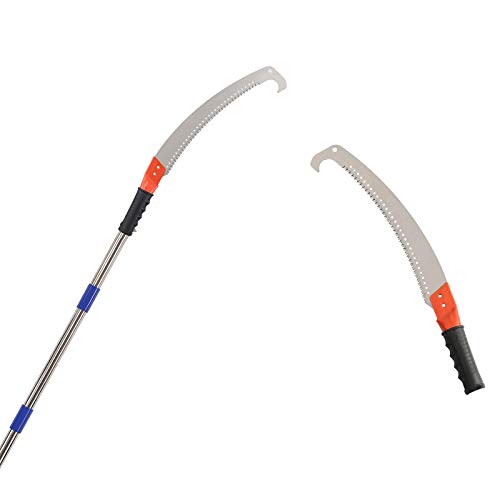
HOSKO 14-FT Long-Reach Manual Pole Pruning Saw keeps the format simple: a 14-foot pole that also becomes a handheld saw for closer work. That gives you a practical way to approach everything from palm fronds and small limbs to higher branches. Compared with the Walensee, its key distinction is a bidirectional edge rather than front and rear hooks.
The three-sided sharpening and opposing barbs support cutting as the blade moves through a branch. Stainless-steel pole sections are suited to outdoor storage where moisture is a regular concern, while the long-reach design handles elevated pruning. The trade-off is that you still control the speed and pressure of every stroke, which can reward technique but tires your arms during a long session.
A Favorable Mix
✓One tool handles elevated branches and lower handheld pruning.
✓The bidirectional blade supports effective cutting in either stroke direction.
✓Stainless-steel pole sections suit exposed outdoor storage conditions.
Points To Note
•Manual operation requires more arm effort than an electric cutting head.
•The fixed 14-foot length offers less positioning flexibility than an adjustable pole system.
•You should assess branch thickness against the tool’s cutting capacity before starting.
Who Will Love This
This HOSKO pick suits gardeners who want a straightforward 14-foot manual saw, a removable handheld format, and a corrosion-resistant pole.
Look Elsewhere When
LETYANGER 7.3-27FT Pole Saw Set fits you better when adjustable reach, branch-scissor access, and a wider range of included components matter more than a fixed-length design.
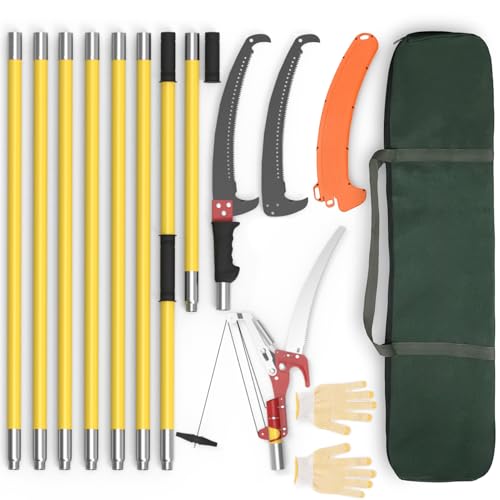
LETYANGER 7.3-27FT Pole Saw Set takes reach as the main adjustable feature. Its seven pole sections extend from about 7.3 feet to 27 feet, giving you much more positioning freedom than the fixed 14-foot HOSKO and Walensee designs. That range works well on a property with both low shrubs and taller trees, provided you have room to assemble and store the sections.
The package includes a saw head, a branch-scissor head, a spare saw with sheath, and a carry bag. Epoxy-resin rods connect through aluminum-alloy joints, while the saw heads use 65Mn alloy steel. You gain two ways to trim, although the longer assembled pole can feel more demanding during extended manual work.
A Strong Showing
✓Adjustable length spans roughly 7.3 to 27 feet.
✓Seven pole sections let you change reach for different tasks.
✓Branch-scissor head adds a second trimming method.
✓Spare saw and sheath add useful backup components.
✓Carry bag helps organize the disassembled kit.
✓Aluminum-alloy joints connect the resin pole sections.
Small Caveats
•The 27-foot maximum requires adequate assembly space and careful handling of the extended pole.
Technical Highlights
Feature
Specification
Why It Matters
Extended length
Approximately 7.3 to 27 feet
Adjusts to different pruning heights.
Number of poles
Seven sections
Builds the tool to different working lengths.
Cutting heads
Saw and branch-scissor heads
Supports sawing and clipping tasks.
Blade material
65Mn alloy steel
Provides a hardened cutting component for manual pruning.
Included storage
Carry bag plus spare saw with sheath
Supports storage and component organization.
Built With In Mind
This set suits you when one large property needs several working lengths, two trimming heads, and organized storage for a long manual tool.
Where A Sibling Pick Shines
Walensee 14-FT 2-in-1 Pole Saw fits you better when you prefer a shorter fixed pole, hook-assisted branch control, and a more compact two-part format.
## What Matters Before You Bring a Pole Saw Outdoors
### Start With The Work Above Ground
A pole saw becomes most useful when its reach matches the branches you routinely handle. Measure a typical pruning area before purchasing, then account for the distance between your body and the branch. The SEESII 21V 8-Inch Pole Saw reaches up to 15 feet, while the LETYANGER set extends to 27 feet, so their practical limits differ substantially.
### Match The Tool To Your Branches
A manual saw works best when its cutting style matches the branch profile and your comfort with physical strokes. Triple-ground teeth and hooks on the Walensee emphasize control, while the HOSKO uses a bidirectional edge. An electric guide bar offers a different cutting approach, but the 8-inch and 10-inch options should be considered alongside the branch sizes you expect to cut.
### Choose Between Muscle And Power
Cordless tools reduce the physical effort of each cut, yet they introduce batteries, chargers, and motor housing. Manual tools avoid that setup and can feel more direct for thin pruning. Your choice depends on how often you work, how high the branches sit, and how comfortable you are with repeated manual strokes.
### Check The Storage And Setup
Long poles need more room than short hand tools. You should consider whether the model collapses, how many sections require assembly, and where the blade and heads will be stored. The LETYANGER set includes a carry bag, while the fixed 14-foot models need a clear place that can support their full length.
## Practical Lessons Before You Buy
### Mistakes Worth Dodging
Choosing by maximum reach alone can leave you with a tool that is awkward for smaller jobs. Check the collapsed or handheld format as well as the extended length, and match the blade or guide bar to the branches involved. For a manual model, confirm that repeated stroking suits you before committing.
### What Separates Premium From Basic
A higher-tier package can add a larger bar, extra batteries, a longer pole, or another cutting head. Those additions matter when your property regularly needs those capabilities. For occasional light pruning, the extra components may add more storage and handling than the task requires.
## Frequently Asked Questions
### Is a manual pole saw better than an electric one?
A manual pole saw gives you direct control without batteries, while an electric model reduces the physical effort of each cut. Your preferred tool depends on branch size, reach, and how comfortable you are with manual strokes.
### How much reach does a professional manual pole saw need?
The right reach matches the height of your typical pruning work. A 14-foot pole suits many residential tasks, while an adjustable model extending to 27 feet provides more positioning range for large properties.
### Is a 10-inch guide bar better than an 8-inch one?
A 10-inch guide bar provides a larger cutting platform for branch work, while an 8-inch bar may be easier to maneuver in confined areas. Compare the branch sizes in your yard with each tool’s stated cutting role.
### Are stainless-steel manual pole saws suitable for outdoor storage?
Stainless-steel construction addresses moisture-related corrosion concerns better than an untreated steel pole. Dry the sections before storage and keep the cutting head protected to preserve its condition.
### What does a 2-in-1 pole saw mean?
A 2-in-1 pole saw converts between a handheld saw and a pole tool. That format gives you flexibility for ground-level trimming and elevated branches without carrying a separate manual saw.
## The Takeaway
The best fit starts with the work you actually do. A manual model gives you direct control, an electric option reduces repeated effort, and adjustable reach serves larger properties with varied pruning heights. Match the tool to your branches, your storage space, and your preferred cutting style, and the choice becomes much clearer.