A grow room can look bright on the wall yet deliver uneven light across the canopy. A PPFD meter, which measures photosynthetically active radiation in micromoles per square meter per second, gives you a more useful picture of what your plants actually receive. The right instrument depends on whether you need a quick canopy reading, daily light totals, spectral details, or a portable phone-based workflow.
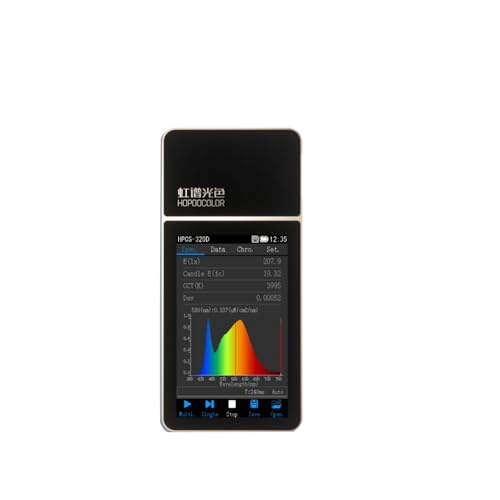
The Hopoocolor HPCS-320D Spectrometer gives you a screen-focused way to evaluate visible fixtures. Its 3.5-inch touch display presents readings in a phone-like layout, which helps during lamp comparisons in a studio, workshop, or grow room. For color and visible-light evaluation, it feels more purposeful than a meter built solely around plant canopy readings.
CCT, or correlated color temperature, describes the color appearance of a light, while CRI, or color rendering index, indicates how faithfully it renders colors. The listed 4 nm FWHM, meaning full width at half maximum, supports broad spectrum work, though it is less suited to separating very narrow spectral lines. Unlike the plant-focused meters later in this list, this model centers on visible-light quality and illuminance.
Notable Upsides
✓The touch display makes changing settings and reading results more direct.
A detached sensor makes the Hopoocolor HPCS-330P particularly useful when the display cannot sit directly beside your plants. You can position the sensor at the canopy and view the results wirelessly, which is convenient for checking multiple points in a dense grow room. The design suits growers who want spectrum data without carrying the display around the tent.
Compared with the HPCS-320D, the HPCS-330P adds a 350 to 800 nm wavelength range and separates the sensor from the display, while its listed wavelength accuracy moves from ±0.5 nm to ±1 nm. It combines PPFD, PAR, lux, CCT, and CRI readings, giving you a broader tool for fixture analysis and plant-light checks. The honest read is that flexibility comes at the cost of slightly broader, rather than tighter, stated wavelength accuracy.
A Favorable Mix
✓Detachable placement gives you more freedom around tall or crowded fixtures.
✓Wireless control reduces the need to carry the display to every measurement point.
✓PPFD, lux, CCT, and CRI readings serve plant and fixture evaluation.
✓The 350 to 800 nm range covers more of the spectrum than visible-light-only tools.
✓A color-temperature range reaching 100,000 K handles varied lamp types.
Practical Considerations
•Wireless readings depend on a compatible device and a stable connection.
•Keeping the sensor and display together is less convenient for remote placement.
•The ±1 nm accuracy figure is less precise than the HPCS-320D listing.
Technical Highlights
Feature
Specification
Why It Matters
Wavelength range
350 to 800 nm
Broad spectral coverage
Color temperature
1,000 to 100,000 K
Wide lamp comparison range
Illuminance
10 to 200,000 lux
Handles many ambient levels
Spectral bandwidth
4 nm FWHM
General spectrum analysis
Wavelength accuracy
±1 nm
Detailed spectral positioning
Made For
The HPCS-330P best serves indoor growers who need remote sensor placement and several lighting measurements in one instrument.
Where A Sibling Pick Shines
The FGI SpotOn Scientific Grade PAR Meter Bundle with 30-Inch Extension Wand and DLI Mode is easier to favor for routine DLI collection and uniformity scans.
The Hopoocolor HPCS-330UV Radiometer changes the subject from plant-usable light to ultraviolet radiation. Its 12 mm detector and separate probe make it practical for placing a sensor close to a UV source while keeping the 3.5-inch display in a more comfortable position. That arrangement is useful in UV-focused testing, inspection, and specialized lighting work.
The spectrum and data display gives you a closer view of the 230 to 450 nm UV band, while a 4 nm FWHM defines its spectral resolution. Wireless connection adds a convenient route for transferring readings. Unlike the HPCC-330P, this model is not a PPFD instrument, so using it for plant-canopy decisions would put the wrong measurement ahead of the right one.
Features That Help
✓The separate probe reaches close to the source without forcing you to watch the screen there.
✓The display shows both spectrum and measurement data for clearer interpretation.
✓Large recording capacity supports a more organized workflow than note-only measurement.
Points To Note
•This UV-focused meter does not replace a dedicated PPFD meter for grow lights.
•The 4 nm bandwidth is not intended for separating extremely narrow spectral lines.
•Wireless viewing requires a compatible device and a working connection.
The Right Fit
You gain the most from the HPCS-330UV when your work involves UVA, UVB, UVC, or total UV radiometry rather than plant PPFD.
Not Your Match When
Choose the EvoDevice PPFD Meter Clip with Diffuser for iPhone when your priority is a compact PPFD check for LED grow lights.
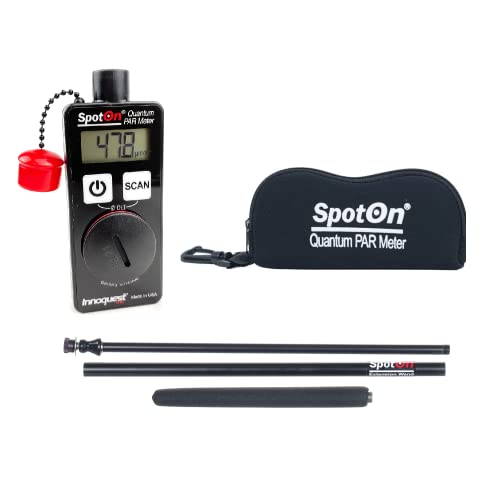
For routine grow-room work, the FGI SpotOn bundle keeps the essential plant-light functions in one handheld instrument. Its quantum sensor measures photons in the photosynthetic range, giving you PPFD in micromoles per square meter per second. The large 0.75-inch display keeps the numbers readable while you move between fixtures, shelves, and the canopy.
DLI, or daily light integral, adds the total usable light received over a 24-hour period, while Scan Mode helps reveal uneven coverage across an area. The 30-inch extension wand improves access to elevated fixtures, and the listed support for LED, sunlight, high-pressure sodium, and metal halide sources makes the meter adaptable. Compared with the HPCS-330P, it prioritizes plant-light workflows over broad spectrum analysis.
Points In Its Favor
✓Spot mode provides an immediate PPFD reading from the canopy or fixture.
✓DLI mode turns a full day of readings into one cumulative figure.
✓Scan mode helps locate dark corners and uneven fixture placement.
✓The extension wand reaches fixtures that would otherwise be awkward to measure.
Trade Offs
•DLI collection requires leaving the meter in place for the full 24-hour period.
•The 30-inch wand adds length that may be inconvenient in tight spaces.
•Uniformity mapping still requires several readings across the growing area.
Quick Facts
Feature
Specification
Why It Matters
Instant measurement
Spot-mode PPFD
Immediate canopy readings
Daily total
24-hour DLI mode
Tracks accumulated light
Area assessment
Scan mode
Checks canopy uniformity
Display
0.75-inch LCD
Readable handheld results
Extension
30-inch wand
Improves fixture access
Who Will Love This
You will find this bundle especially practical for indoor growers who need PPFD, DLI, and canopy-uniformity measurements without several separate tools.
Reach For A Different Pick When
The Hopoocolor HPCS-330P PAR Meter is a stronger fit when wavelength coverage and a detachable, wireless sensor matter more than DLI recording.
A phone is already in your pocket, which makes the EvoDevice PPFD Meter Clip with Diffuser for iPhone an appealing choice for quick grow-light checks. The clip fits over the iPhone’s front camera and uses the MoeuPLTest PAR app to report PPFD in micromoles per square meter per second. It fits a casual setup session or a spot check without carrying a separate display.
An integrated diffuser helps spread incoming light across the camera sensor during measurement, reducing the chance of a strongly directional reading. Compared with the FGI SpotOn Scientific Grade PAR Meter Bundle with 30-Inch Extension Wand and DLI Mode, the EvoDevice setup is smaller and app-based, but it does not provide the same dedicated DLI and scan functions. For most casual checks, that compact trade can be reasonable.
Practical Pluses
✓The clip-and-phone format minimizes the equipment you need for a basic PPFD reading.
✓The diffuser helps distribute light across the camera sensor during use.
Small Caveats
•You need a compatible iPhone and the MoeuPLTest PAR app for the stated workflow.
•Confirm that the clip fits your phone and case before committing to it.
•A camera-based clip offers less dedicated measurement functionality than a standalone quantum-sensor meter.
Best Suited To
This clip best suits casual growers who want a lightweight PPFD check for an LED fixture and already use their iPhone during setup.
Another Choice May Suit
The DANOPLUS 2-in-1 PAR DLI Meter with 5-Year Data Storage and CSV Export suits growers who need long-term light records and computer exports.
Seasonal growers often need more than a single PPFD reading, and the DANOPLUS 2-in-1 PAR DLI Meter handles both instant light levels and daily totals. It measures across a 400 to 700 nm band with a PPFD range of 0 to 5,000 micromoles per square meter per second. That makes it a sensible choice for comparing grow lights, greenhouse conditions, and outdoor plant exposure.
The main advantage appears in the records. The meter can store up to five years of DLI data, display 30 days of history and photoperiod information, and export records to a computer as CSV files, which is a comma-separated text format suited to spreadsheets. Compared with the FGI SpotOn bundle, the DANOPLUS places more emphasis on long-term storage and export, while the FGI adds canopy scanning and a 30-inch wand.
The Value In It
✓PPFD and DLI functions cover both instant and daily light requirements.
✓Five years of onboard storage supports seasonal and multi-year records.
✓CSV export makes the data easier to organize in spreadsheet software.
✓The broad PPFD range covers many indoor and outdoor lighting conditions.
✓Thirty-day history helps reveal changes in the growing environment.
Details To Watch
•DLI results depend on leaving the meter in position for a complete day.
•The 400 to 700 nm range focuses on plant-relevant light rather than full-spectrum analysis.
Feature Snapshot
Feature
Specification
Why It Matters
Wavelength range
400 to 700 nm
Covers plant-relevant light
PPFD range
0 to 5,000 μmol/m²/s
Handles varied light levels
Data storage
Up to 5 years
Supports long-term tracking
Export
CSV via computer connection
Simplifies spreadsheet analysis
Built With In Mind
The DANOPLUS fits growers, greenhouse operators, and plant researchers who want a multi-year DLI record alongside immediate PPFD readings.
Swap It Out When
The FGI SpotOn Scientific Grade PAR Meter Bundle with 30-Inch Extension Wand and DLI Mode is better suited to quick canopy uniformity scans with an extension wand.
## Matching Measurement Goals To Your Setup
### Know The Numbers You Need
Start with the decision you need to make. A PPFD reading tells you the light intensity at one moment, while DLI accumulates that exposure over 24 hours. For lamp comparison, instant PPFD is usually enough; for seasonal crops, long-term DLI records reveal how daily light changes over time.
### Match The Sensor To The Fixture
Check the wavelength range and measurement modes before you buy. A visible-light spectrometer with CCT and CRI details suits fixture evaluation, while a 400 to 700 nm PAR meter concentrates on plant-relevant radiation. Detachable sensors and extension wands help when the canopy sits above, below, or behind dense foliage.
### Plan Around Data Handling
Consider where readings will live. A phone clip keeps the workflow compact, a standalone meter suits recurring spot checks, and a model with CSV export supports long-term record analysis. DLI collection also requires a full day of placement, so plan a location that will remain undisturbed and keep the sensor exposed to the same light your plants receive.
## Two Details That Change The Decision
### Common Shopping Slip Ups
Avoid focusing on PPFD alone when your real goal is a daily light total or a uniformity map. You also need to confirm the wavelength range, sensor placement, and any app or computer requirements before purchasing. A compact tool is convenient, but it may not replace a dedicated quantum sensor for routine professional records.
### What Separates Premium From Basic
Higher-cost instruments commonly add broader spectrum coverage, detachable probes, larger displays, or longer-term data storage. Those features become worthwhile when you repeatedly measure multiple fixtures, track crops through a season, or need records you can export and compare. A basic phone clip or dedicated PAR meter remains sensible for occasional checks.
## Frequently Asked Questions
### What Is A PPFD Meter Used For?
A PPFD meter measures photosynthetically active light at a specific point, usually in micromoles per square meter per second. You can use it to compare grow lights, check canopy intensity, and identify uneven lighting.
### Do I Need PPFD Or DLI Measurements?
PPFD provides an instant reading, while DLI totals usable light across 24 hours. You need PPFD for immediate fixture or canopy checks, and DLI for tracking a plant’s accumulated daily light exposure.
### Can A Phone Replace A Dedicated PAR Meter?
A phone clip offers a compact workflow for occasional LED grow-light checks. A dedicated quantum-sensor meter provides a purpose-built instrument for recurring readings, DLI collection, and canopy mapping.
### What Does A Detachable Sensor Add?
A detachable sensor lets you position the sensing element away from the display. This helps with elevated fixtures, crowded canopies, and remote measurements where carrying both pieces would be awkward.
### Which PPFD Meter Suits Outdoor Planting?
A meter with DLI logging and long-term storage works well for tracking changing outdoor light. The 400 to 700 nm DANOPLUS model also measures the plant-relevant spectrum used for PPFD, while its CSV export supports later analysis.
## Wrap Up
The FGI SpotOn bundle fits routine indoor plant-light work, while the DANOPLUS model favors long-term DLI records. For spectral detail, the Hopoocolor HPCS-320D and HPCS-330P serve different visible-light and broader-spectrum needs, and the EvoDevice clip keeps occasional phone-based checks simple. Choose the measurement workflow that matches your space and the decisions you need to make.