

PAR, or photosynthetically active radiation, describes the light plants can use for photosynthesis within the conventional 400-700 nm range. An ePAR meter extends that coverage to 750 nm, while PPFD shows instantaneous light intensity and DLI, or daily light integral, totals usable light over a day. You need different measurements for a home tent, a greenhouse bench, and a multi-level rack, so the right meter depends on whether you need spot readings, logged data, or both.
The Essentials At A Glance

Apogee Instruments DLI-600 ePAR, DLI and Photoperiod Meter, 400-750 nm

Apogee MQ-610 ePAR Quantum Meter, 400-750 nm

Apogee MQ-500 Quantum PAR Meter, Digital PPFD

Apogee DLI-500 PAR, DLI and Photoperiod Meter, 400-700 nm

Apogee Instruments MQ-610 ePAR Meter with AM-330 Telescopic Wand
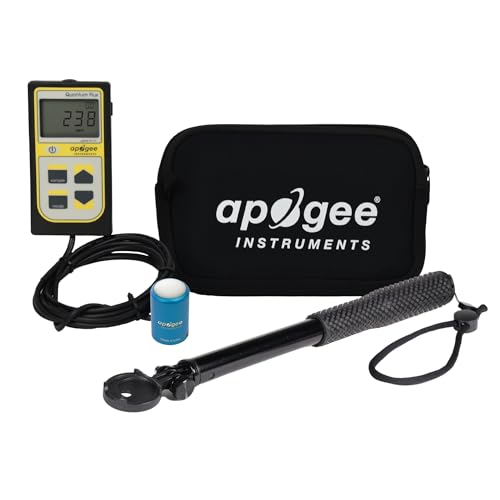
Apogee MQ-500 Quantum PAR Meter with AM-330 Telescopic Wand
The Strengths Of Each Pick
The DLI-600 is built for grow rooms where a single PPFD reading is only part of the decision. It records spot measurements, daily light integral, and photoperiod through 400-750 nm, giving you a fuller account of the light reaching a crop over time.
Its USB-C data transfer and 99-day recording capacity suit controlled indoor research or advanced crop monitoring. For a simple fixture check, the Apogee MQ-610 ePAR Quantum Meter, 400-750 nm is the more direct choice, while this model earns its place when daily records matter.
Reasons It Performs
- Measures the extended 400-750 nm ePAR band, including far-red light that falls beyond traditional PAR limits.
- Tracks DLI and photoperiod for growers who manage lighting schedules by daily exposure rather than one reading.
- Stores photoperiod in 0.2-hour increments across up to 99 days, supporting longer comparisons.
- USB-C transfer lets you save ePAR, DLI, and photoperiod data for analysis outside the meter.
- Its IP65 sealing rating and included soil stake suit greenhouses and other demanding placements.
Things To Consider
- The recording and download features add complexity when you only need an occasional spot reading from a tent.
Key Specs
Built With In Mind
This model fits serious greenhouse growers, plant researchers, and advanced indoor growers who need daily light records rather than a basic PPFD snapshot.
Where Another Pick Suits Better
The Apogee MQ-610 ePAR Quantum Meter, 400-750 nm suits grow-room users who want far-red-aware spot readings without the DLI-600’s logging workflow.
Modern LED fixtures increasingly include wavelengths that fall outside the conventional 400-700 nm PAR range. The MQ-610 addresses that gap by measuring 400-750 nm, including the 700-750 nm far-red region that standard PAR meters can omit.
In a densely rigged greenhouse, that broader coverage may provide a more useful picture of fixture output. The machined aluminum sensor head and tangle-free cable also suit repeated canopy checks, whereas the Apogee MQ-500 Quantum Meter, Digital PPFD remains better suited to conventional PAR measurements.
Useful Strengths
- Extends to 750 nm so far-red output is included in ePAR readings.
- Provides a practical way to compare modern LED fixtures, sunlight, and other plant-light sources.
- The potted aluminum sensor head is designed to resist water and handling in a greenhouse.
- A tangle-free cable improves positioning across a broad canopy while keeping the display visible.
Worth Noting
- Its extended range provides little practical advantage when the fixture operates entirely within 400-700 nm.
- For daily exposure and schedule tracking, the DLI-600 offers functions this spot meter does not emphasize.
Technical Sheet
Made For
Greenhouse growers and advanced indoor cultivators using broad-spectrum LED fixtures benefit most from its far-red-aware measurements.
A Better Fit Elsewhere
The Apogee Instruments DLI-600 ePAR, DLI and Photoperiod Meter, 400-750 nm better fits growers who need recorded daily exposure and photoperiod data.
The MQ-500 keeps the measurement task focused on 400-700 nm light and digital PPFD, the instantaneous measure used to compare intensity across a grow canopy. It supports spot or logged measurements, which makes it useful for tuning a fixture or checking how light changes from one growing area to another.
For a home tent using conventional LEDs, that narrower scope is likely enough. The Apogee MQ-610 ePAR Quantum Meter, 400-750 nm becomes the more relevant option once far-red output enters the setup, while this model favors a more focused workflow.
What Earns Its Place
- Digital PPFD output gives you a direct way to evaluate light intensity at the crop canopy.
- Logged measurements support comparisons across multiple positions or growing periods.
- The potted aluminum sensor and tangle-free cable suit regular placement around plant racks.
Minor Gripes
- Its 400-700 nm range does not account for far-red light between 700 and 750 nm.
- It focuses on quantum measurements rather than the DLI and photoperiod records available from the DLI models.
- The attached cable requires a little more care around tightly packed branches and trellises.
Right Fit For
Home growers and educators checking conventional LED grow lights benefit from its clear focus on 400-700 nm PPFD measurements.
Consider Something Else When
Choose the Apogee MQ-610 ePAR Quantum Meter, 400-750 nm when your fixture includes far-red wavelengths that this model leaves outside its range.
The DLI-500 turns conventional PAR measurements into a longer record of light exposure. It measures PPFD, daily light integral, and photoperiod across 400-700 nm, then records photoperiod in 0.2-hour increments for as long as 99 days.
That makes it a practical choice for greenhouse management and plant work centered on conventional PAR. Compared with the DLI-600, its range stops at 700 nm, so the extended ePAR model remains the better fit for fixtures with meaningful far-red output.
Everyday Wins
- Combines instantaneous PPFD, daily totals, and photoperiod in one instrument.
- Long recording periods support comparisons across successive crop or lighting cycles.
- The standard PAR range fits many greenhouse and indoor fixtures that operate below 700 nm.
- Spot measurements provide a quick way to establish a canopy baseline before making schedule changes.
Small Caveats
- Photons from 700-750 nm are excluded, so the reading can underrepresent far-red-heavy fixtures.
- Daily logging is more involved than a straightforward spot check for a casual home setup.
Quick Facts
Who Will Love This
Greenhouse operators and plant-focused growers who need daily PAR records will appreciate the combination of spot, DLI, and photoperiod information.
Where A Sibling Pick Shines
The Apogee Instruments DLI-600 ePAR, DLI and Photoperiod Meter, 400-750 nm serves growers who need the same daily tracking with broader spectral coverage.
The MQ-610 bundle adds an AM-330 telescopic sensor wand to the same 400-750 nm ePAR meter used for advanced spot measurements. That combination matters in tall grow rooms, where moving a standard sensor to every shelf can be awkward and may encourage inconsistent placement.
You may find the wand especially helpful for checking a multi-level rack without repeatedly rearranging equipment. For a single bench or low canopy, the standard Apogee MQ-610 ePAR Quantum Meter, 400-750 nm offers the same core measurement range in a more compact arrangement.
Notable Upsides
- Includes the MQ-610’s extended 400-750 nm measurement range for far-red-aware readings.
- The telescopic wand places the sensor at different canopy heights with less climbing or repositioning.
- Machined aluminum construction gives the sensor head a substantial, durable feel.
- The high-contrast display remains useful while the sensor is positioned away from the meter body.
Trade Offs
- The extra wand hardware is unnecessary when all measurements are taken at one reachable height.
- It remains a spot meter rather than a dedicated DLI and photoperiod recorder.
Whose Shelf It Belongs On
Multi-level indoor growers and greenhouse operators with tall or awkward fixtures benefit most from the added reach.
Reach For A Different Pick When
The Apogee Instruments DLI-500 PAR, DLI and Photoperiod Meter, 400-700 nm better fits growers who need daily exposure records more than elevated spot readings.
The MQ-500 wand bundle pairs a conventional 400-700 nm quantum meter with the AM-330 telescopic sensor wand. It measures photosynthetic photons through instantaneous or logged readings, giving you both quick PPFD checks and a way to document measurements across a canopy.
In a crowded room, the wand’s reach may matter more than broader spectral coverage. The bundle works particularly well for standard LED fixtures, while the Apogee Instruments MQ-610 ePAR Meter with AM-330 Telescopic Wand is the closer match for far-red-heavy installations.
The Helpful Details
- Logged and instantaneous measurements support both quick checks and ongoing comparisons.
- The telescopic wand simplifies readings above benches or on tightly spaced shelving.
- Water-resistant potted aluminum construction suits routine greenhouse placement.
Possible Compromises
- Its 400-700 nm range leaves out the 700-750 nm far-red region.
- The wand adds length to store and handle in a compact work area.
- It does not provide the dedicated DLI and photoperiod workflow found in the DLI meters.
Feature Snapshot
Who Should Grab It
Home growers with tall shelving or standard LED fixtures will find the wand practical for checking PPFD at several canopy heights.
Swap It Out When
The Apogee Instruments MQ-610 ePAR Meter with AM-330 Telescopic Wand is the stronger choice when accurate far-red coverage matters.
What Matters Before You Choose A Light Meter
Start With The Light Source
Your fixture’s spectral range should guide the first decision. The MQ-500 and DLI-500 cover 400-700 nm, which suits conventional PAR measurement. The MQ-610 and DLI-600 extend to 750 nm, making them more relevant for fixtures with meaningful far-red output.
Match The Reading To The Task
PPFD answers how intense the light is at a measured point. DLI adds the cumulative light received across a day, while photoperiod records how long the light remains on. Serious growers may need all three, whereas a simple fixture comparison can start with an instantaneous reading.
Account For The Growing Space
Tall racks and densely packed benches make sensor reach a practical concern. The MQ-500 and MQ-610 wand bundles can place the sensor at elevated or awkward positions, while the DLI-600 includes a soil stake for repeated placement in a growing area.
Check The Data Workflow
Consider whether an on-screen reading is enough or whether you need stored records and USB-C transfer. The DLI meters emphasize daily integration and photoperiod tracking, whereas the MQ models center on instantaneous and logged quantum measurements.
Common Mistakes Worth Avoiding
Pitfalls Shoppers Hit
Choosing by a fixture’s advertised wattage can distract from the measurement you actually need. Match the meter to the wavelength range, confirm whether you need daily records, and consider canopy height before focusing on accessories. A more elaborate meter adds no value if its extra data does not guide your setup.
What The Higher Tier Buys
The DLI-600 and extended-range models add capabilities that matter for advanced crop work, including 400-750 nm coverage, daily light integration, and photoperiod records. The upgrade makes sense for far-red fixtures or long-term monitoring. For conventional LEDs and occasional canopy checks, a focused MQ model may be the more practical choice.
Frequently Asked Questions
What Is A PAR Meter For Led Grow Lights?
A PAR meter for LED grow lights measures the light intensity that plants can use for photosynthesis, commonly expressed as PPFD. It helps you compare fixture output and identify uneven lighting across a canopy.
Is ePAR Better Than Standard PAR?
ePAR is more useful when your fixture includes wavelengths beyond 700 nm because it measures from 400 to 750 nm. For a fixture operating entirely within 400-700 nm, a standard PAR meter may provide the information you need.
Do I Need A PAR Meter With A Sensor Wand?
A sensor wand helps when the canopy is tall, crowded, or difficult to reach. You can check several heights without repeatedly moving the display, which supports more consistent placement across a multi-level setup.
What Is The Difference Between PPFD And DLI?
PPFD measures light intensity at one moment, while DLI totals the usable light delivered over an entire day. Use PPFD for canopy comparisons and DLI for lighting schedule and daily exposure decisions.
Can One Meter Measure Both Sunlight And Grow Lights?
Many quantum meters can measure different light sources, including sunlight and LED fixtures. Confirm that the selected model covers the wavelength range of the light you need to evaluate, especially when far-red output is important.
Final Verdict
Start with the measurement your setup actually needs. Conventional LEDs and occasional canopy checks point toward the MQ-500, while far-red fixtures call for an MQ-610 or DLI-600. Daily exposure records and elevated planting spaces narrow the choice further, making a little planning before you buy worthwhile.
