

Watering a windowsill fern by memory rarely works, especially when some pots dry out faster than others. A moisture meter gives you a quick soil-based reading, while a light meter helps you check whether a windowsill or grow light delivers enough usable light. You’ll find compact tools for routine houseplant care alongside more capable instruments for greenhouses, research, and serious indoor growing.
The Main Contenders

Thlevel Plant Moisture Meter, Plant Water Meter, Green 2-Pack, No Batteries Required
Pexio PretiHom Soil Moisture Meter, pH and Light Tester

Apogee Instruments MQ-610 400-750 nm ePAR Quantum Meter

Apogee Instruments MQ-500 Full-Spectrum Quantum PAR Meter

Apogee Instruments MQ-610 ePAR Meter with AM-330 Telescopic Wand
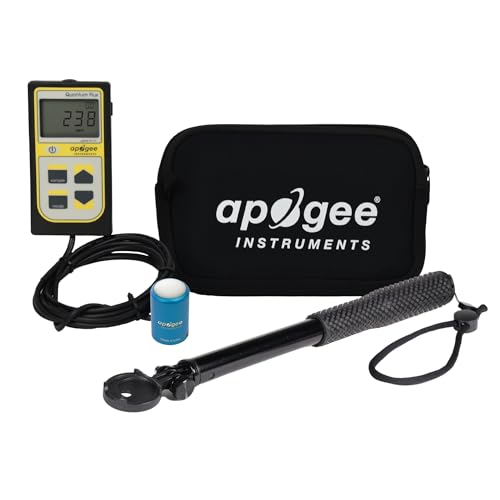
Apogee Instruments MQ-500 PAR Meter with AM-330 Wand
What Each Pick Brings To The Table
Two pots on the same shelf can need very different watering schedules, so a simple dial reading can prevent guesswork. The Thlevel meter uses a stainless steel probe and a color-coded face with ten scales, giving you an immediate moisture indication without batteries or charging.
For a busy home with many indoor plants, the two-pack is practical because you can keep one meter in use and the other nearby. It also suits outdoor pots, lawns, and garden plants, although you’ll get more benefit from a single-purpose tool than from a broad diagnostic meter.
Standout Benefits
- No batteries keep the meter ready for spontaneous watering checks.
- The large, color-coded dial makes moisture categories easy to recognize.
- Two meters let you check separate plant groups without repeatedly moving one device.
- The stainless steel probe suits routine insertion into soft potting soil.
Small Caveats
- It measures moisture only, so it cannot assess soil acidity or light.
- Keep the probe away from stones and very hard soil, and don’t leave it inserted for long periods.
- The dial gives a broad moisture indication rather than a precise digital value.
Quick Facts
Made For Everyday Plant Care
You’ll benefit most from this meter if you maintain several houseplants and want a simple, battery-free moisture check for soft potting soil.
Another Choice May Suit
The Pexio PretiHom Soil Moisture Meter, pH and Light Tester offers more functions when you also need soil pH and light information.
Unlike the Thlevel meter’s single moisture function, the Pexio PretiHom combines moisture, pH, and light readings in one compact soil tool. That broader coverage helps you investigate several plant-care questions without juggling separate instruments.
The dual-probe design is inserted about four to five inches into the soil, making it more relevant for room-sized pots than tiny containers. For beginners or mixed collections, the multiple modes offer a convenient starting point, though the readings remain practical indicators rather than laboratory analysis.
What Helps Most
- Three-in-one checking covers moisture, pH, and sunlight in one device.
- The mode selector lets you focus on the condition you’re investigating.
- No batteries remove setup friction from routine plant checks.
- The portable body works across houseplants, lawns, greenhouses, and garden beds.
Points To Note
- Use it only in soil, not directly in water or liquid fertilizer.
- Rocks and hard ground can make probe placement inconsistent.
- Clean the metal probes after use and allow more time for the display to stabilize.
Who Will Love This
This meter suits home gardeners who want moisture, soil pH, and light guidance for a varied collection of plants.
A Better Fit Elsewhere
The Thlevel Plant Moisture Meter, Plant Water Meter, Green 2-Pack, No Batteries Required is simpler and better suited to watering checks alone.
This pick changes the measurement entirely: the MQ-610 evaluates plant-related light rather than soil moisture. Extended PAR, or ePAR, expands the conventional 400-700 nanometer range to 400-750 nanometers, adding the far-red portion used by some modern LED fixtures and sunlight.
You’ll find this instrument most relevant in a greenhouse, plant laboratory, or carefully managed indoor grow room where fixture placement and canopy output matter. Compared with the Pexio PretiHom, it offers a much more specialized light profile, but it cannot tell you when a pot needs water.
The Upside
- The 400-750 nm range captures far-red photons missed by conventional PAR readings.
- Quantum-meter measurements suit detailed grow-light and canopy comparisons.
- A potted, machined aluminum sensor head is built for rugged outdoor placement.
- The tangle-free cable supports measurements across a broad plant canopy.
Where It May Fall Short
- It provides no soil moisture, pH, or watering information.
- The instrument is excessive for routine houseplant care and may take study to interpret.
Technical Highlights
Right Fit For
You’ll benefit most from the MQ-610 as a greenhouse specialist or serious indoor grower evaluating extended-range LED lighting.
Swap It Out When
The Pexio PretiHom Soil Moisture Meter, pH and Light Tester fits you better when basic watering and soil-condition checks matter more than precise canopy measurements.
The MQ-500 focuses on photosynthetic active radiation, commonly shortened to PAR, across 400-700 nanometers. Its digital quantum-meter output can provide instantaneous readings or logged measurements, making it easier to compare positions around a grow canopy or record how fixture output changes.
Compared with the MQ-610, its spectral range stops at 700 nanometers, so it does not separately capture far-red output. That makes it a practical choice for sunlit greenhouses and conventional full-spectrum fixtures, especially when you need digital records rather than a simple dial indication.
Positive Takeaways
- Digital PAR readings make repeated light comparisons easier to record.
- The detector supports instantaneous and logged measurements.
- A rugged, waterproof aluminum sensor suits greenhouse placement.
- The tangle-free cable supports positioning around plant canopies.
Honest Caveats
- It measures light, not soil moisture, so it cannot guide watering directly.
- Far-red output is outside its 400-700 nanometer range.
- Adding the telescopic sensor wand would be useful for elevated canopies.
Built With In Mind
This meter suits greenhouse operators and indoor growers who need dependable digital PAR readings within the 400-700 nanometer range.
Look Elsewhere When
The Apogee Instruments MQ-610 400-750 nm ePAR Quantum Meter is the better fit when your lighting setup includes far-red wavelengths.
The MQ-610 bundle adds an AM-330 telescopic wand to the extended-range light meter seen earlier. This matters when your plants sit above head height, inside a tall cabinet, or beneath a fixture positioned beyond the reach of a loose cable.
You’ll appreciate the combination for greenhouses and vertical grow systems, where the sensor needs to be placed at canopy level without moving heavy pots. For a desk garden or low shelf, however, the separate wand may add more handling and storage than the standard MQ-610 configuration.
Well-Handled Touches
- The telescopic wand places the sensor at elevated canopy positions.
- The meter retains the 400-750 nanometer extended range.
- Far-red output is included for modern LED fixture comparisons.
- The sensor head uses rugged, waterproof aluminum construction.
Possible Compromises
- The wand is unnecessary for plants located at desk or bench height.
- It still provides no soil moisture or pH reading.
Whose Shelf It Belongs On
This bundle fits greenhouse growers and indoor cultivators who need extended-range light readings at an elevated canopy height.
Reach For A Different Pick When
The Apogee Instruments MQ-500 Full-Spectrum Quantum PAR Meter suits you better when 400-700 nanometer measurements and direct cable placement meet your needs.
Pairing the MQ-500 with the AM-330 wand gives you digital PAR readings plus easier access to elevated or enclosed canopies. You can place the sensor above a dense plant bed, near the top of a tall shelf, or at the center of a broad canopy while keeping the display within reach.
Compared with the MQ-610 bundle, this combination covers 400-700 nanometers and stops short of far-red measurement. It remains a strong fit for sunlight and conventional grow lights, while the wand makes the setup more useful across a greenhouse bench or multi-level installation.
Where It Delivers
- The AM-330 wand simplifies measurements above benches and on tall shelves.
- Digital output supports instantaneous and logged canopy readings.
- The 400-700 nanometer range suits sunlight and standard PAR analysis.
- The sensor head is machined from aluminum and fully potted for rugged use.
Details To Watch
- It does not include far-red measurement beyond 700 nanometers.
- No soil moisture information is available from this instrument.
- The telescopic setup requires room to handle and store the wand.
Core Details
The Right Fit
You’ll benefit most from this bundle as a greenhouse grower who needs digital canopy readings from plants at varying heights.
Consider Something Else When
The Apogee Instruments MQ-610 400-750 nm ePAR Quantum Meter is the stronger choice for lighting setups that include far-red wavelengths.
What To Look For Before Buying A Plant Meter
Start by deciding which condition you actually need to measure. Soil moisture tools answer watering questions, while light meters quantify the photosynthetic light reaching a canopy. The Pexio PretiHom combines moisture, pH, and light, whereas the Apogee models concentrate on light measurements.
Choose The Measurement You Need
An analog soil meter works well for quick checks across multiple houseplants. The color scale provides a directional reading, which is usually enough to decide whether a pot needs more water. A digital 3-in-1 tool adds pH and light information, giving you a broader view of growing conditions without multiple devices.
Match The Probe To Your Plants
Probe depth and container size influence the result. The Pexio PretiHom is inserted four to five inches into the soil, so it suits larger pots better than a shallow planter. The Thlevel probe is also intended for insertion to root level, but its simpler dial makes it most useful for routine moisture checks in soft potting soil.
Understand Light-Meter Ranges
PAR describes light in the 400-700 nanometer range that plants can use for photosynthesis. The MQ-610 extends that range to 750 nanometers, adding far-red light found in some modern LED fixtures. You’ll need the extended model for far-red analysis, while the MQ-500 remains focused on standard PAR and sunlight.
Account For Canopy Height
Your fixture height and plant arrangement affect light placement more than the meter’s display. The AM-330 telescopic wand makes both MQ bundles easier to position around tall shelves and greenhouse canopies. A standard configuration can be more convenient for a low bench, though the sensor cable still needs room to reach your measurement point.
Common Mistakes To Avoid
Mistakes Worth Dodging
Don’t expect a soil meter to measure light, or a PAR meter to tell you when to water. A single reading also isn’t a complete plant diagnosis, so consider pot drainage, soil type, and the plant’s normal care requirements before changing your routine.
What Separates Premium From Basic
Basic meters emphasize quick, inexpensive soil readings. Advanced instruments offer broader spectral ranges, digital output, recording options, rugged sensor housings, and telescopic positioning. The added capability is worthwhile for professional growing, greenhouse work, or carefully managed indoor setups, while basic houseplant care usually needs less instrumentation.
Frequently Asked Questions
Do moisture meters work for indoor and outdoor plants?
Yes, they work in both settings when you insert the probe into suitable soil. Keep the probes away from stones and hard ground, and use the tool only for soil rather than standing water.
Can one meter check moisture, pH, and light?
The Pexio PretiHom model includes moisture, pH, and light functions. The Thlevel meter focuses only on moisture, while the Apogee instruments measure light across selected spectral ranges.
What is the difference between PAR and ePAR?
PAR covers 400-700 nanometers, the conventional range associated with photosynthetic light. The MQ-610 uses extended PAR to cover 400-750 nanometers, adding far-red wavelengths found in some modern LED fixtures.
Do I need a telescopic wand for a grow light?
You need one when your canopy is elevated or difficult to reach with the standard cable. The AM-330 wand helps position the sensor at plant height, while low benches and shelves may be easier to measure without it.
Are battery-free soil meters easier to maintain?
They remove battery charging and replacement from the routine. You still need to handle the probe carefully, clean it after use, and avoid hard soil, stones, liquids, and long periods of insertion.
Final Verdict
The Thlevel two-pack is the simplest fit for everyday watering checks, while the Pexio PretiHom adds pH and light readings in one soil tool. The four Apogee choices serve a different purpose: measuring plant-related light with increasing spectral range and placement flexibility. Match the instrument to the condition you need to monitor, then keep the setup simple enough to use consistently.
